Category: Transport & Mobility

  • The Ultimate Guide to Eco-Friendly Backpacks: Sustainable, Stylish, and Built for Modern Life

    Keeping It All Together Without Costing the Earth

    If you’ve ever rummaged through three tote bags, a gym sack, and a coat pocket at 7:45 AM trying to find your laptop charger, you already understand the core promise of a good backpack: everything has a place, and everything is in its place. In a world that increasingly pulls us between locations—home office, co-working space, train platform, trailhead, coffee shop—the backpack has quietly become the modern person’s most trusted companion.

    But here’s the tension: the backpack industry is enormous, largely synthetic, and not particularly kind to the planet. Most mainstream backpacks are constructed from virgin polyester, nylon, and PU-coated fabrics—materials derived from petroleum, shed microplastics with every wash, and end up in landfills after a few years of zipper failures and frayed straps. So how do you choose a backpack that serves your life and aligns with your values?

    This guide walks through everything you need to know: materials, sizing, ergonomics, water resistance, brand transparency, and—crucially—a mindset shift that might mean you need less bag than you think.


    Why Your Backpack Choice Matters More Than You Think

    Let’s start with some context. The global backpack market was valued at roughly $18 billion in the late 2010s and has only grown since. The environmental footprint of that market is significant: producing a single polyester backpack requires petroleum extraction, energy-intensive polymerization, textile weaving, dyeing (often with toxic chemicals), and global shipping. Multiply that by the hundreds of millions of backpacks produced annually, and the cumulative impact is staggering.

    Meanwhile, the average backpack is used for just 2–3 years before being replaced. Cheap construction, changing fashion trends, and planned obsolescence in zippers and stitching all contribute to a throwaway culture around an item that could—and should—last a decade or more.

    Choosing an eco-friendly backpack is a small act with outsized ripple effects. It signals demand for better materials, supports companies investing in sustainable supply chains, and keeps synthetic waste out of landfills and oceans. Done well, it also gives you a more durable, more beautiful, and more functional piece of everyday gear.


    Understanding Eco-Friendly Backpack Materials

    The single most important factor in a backpack’s environmental impact is its material composition. Here’s a deep dive into the main categories:

    Natural Fibres: Canvas, Hemp, and Cotton

    Waxed canvas is the standout here. Cotton canvas—typically 14oz to 18oz weight—coated with a blend of waxes (paraffin, beeswax, or plant-based alternatives) creates a naturally water-resistant, incredibly durable fabric. It ages beautifully, developing a patina that many people find more attractive over time. Brands like Fjällräven (with their G-1000 fabric) and Topo Designs have popularized this approach.

    Hemp is arguably the most sustainable natural fibre for bags. It grows densely, requires minimal water and no pesticides, improves soil health, and produces a fabric that’s stronger than cotton. However, hemp backpacks remain relatively niche, and the texture can be coarser than some users prefer.

    Organic cotton (non-waxed) is breathable and pleasant but lacks water resistance. It’s best suited for dry climates or as an inner lining material.

    Recycled Synthetics: rPET and Recycled Nylon

    Recycled polyethylene terephthalate (rPET) is made from post-consumer plastic bottles. It diverts waste from landfills and requires significantly less energy to produce than virgin polyester. Many forward-thinking brands—Patagonia, Fjällräven, Evergoods—now use rPET extensively.

    The caveat: rPET is still plastic. It still sheds microplastics, and at end of life it’s still difficult to recycle again. It’s better than virgin polyester, but it’s not a perfect solution. Think of it as harm reduction rather than environmental regeneration.

    Recycled nylon (often branded as ECONYL) is similar—made from recovered fishing nets and industrial plastic waste. It’s more durable than rPET and better suited to heavy-duty applications, but carries the same end-of-life concerns.

    Leather: The Complicated Classic

    Full-grain vegetable-tanned leather is naturally water-resistant, extraordinarily durable (decades, not years), and biodegradable at end of life (unlike chrome-tanned leather). It’s also a byproduct of the meat industry, which means it doesn’t directly require animal agriculture for its existence—but it’s economically tied to it, which is a consideration for vegans.

    Chrome-tanned leather, which accounts for the vast majority of global leather production, uses toxic chromium salts and generates significant wastewater pollution. If you choose leather, look specifically for vegetable-tanned, full-grain hides, and ideally from tanneries with certified environmental standards (e.g., LWG Gold-rated tanneries).

    Emerging Materials: Piñatex, Cork, and Bio-Based Polymers

    Piñatex (pineapple leaf fibre) and cork are gaining traction as vegan leather alternatives. Both are biodegradable and derived from renewable sources. Their durability in high-stress applications (like backpack bottoms and strap attachments) remains less proven than traditional materials, but they’re improving rapidly.

    Bio-based polymers, partially derived from castor oil or corn starch, are beginning to appear in hardware and buckles, reducing reliance on fossil-fuel-based plastics.


    Material Comparison at a Glance
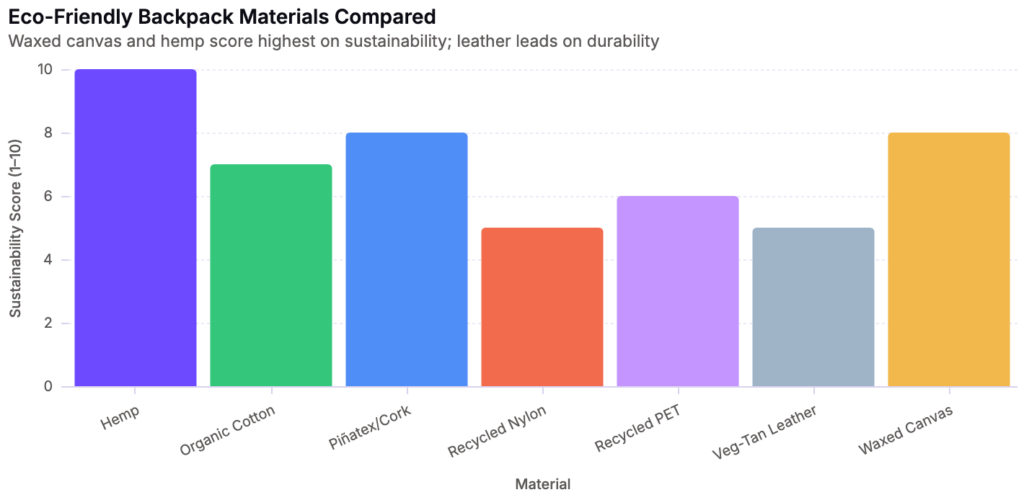
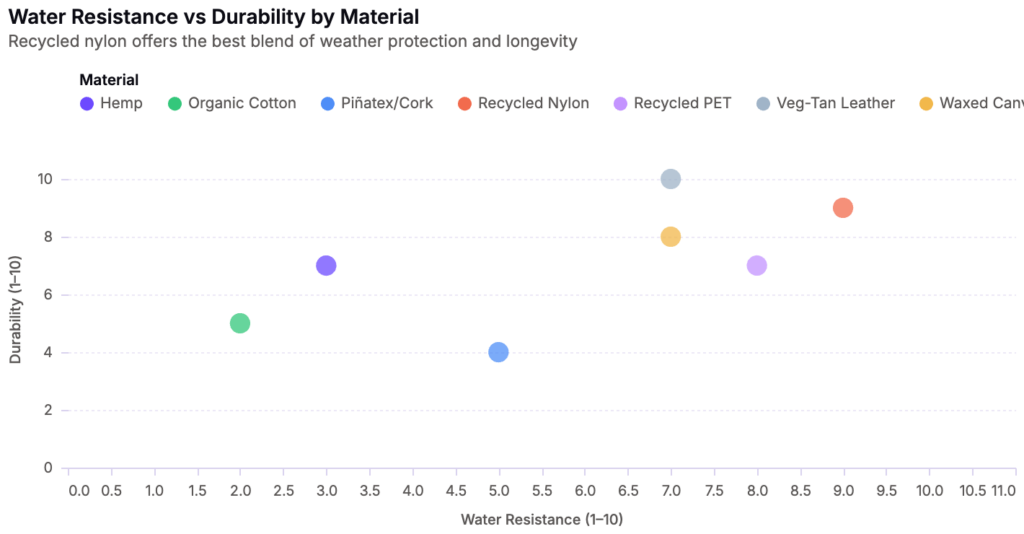
    Chart showing water resistance vs durability by Material choice

    These chart illustrate a fundamental trade-off in sustainable backpack shopping: the most eco-friendly materials (hemp, organic cotton) tend to offer the least weather protection, while the most weather-resistant options (recycled nylon, rPET) are still fundamentally plastic. Waxed canvas occupies a sweet spot—natural, reasonably water-resistant, and highly durable—but it’s heavier than synthetic alternatives.


    Choosing the Right Size: The Goldilocks Problem

    Size is where most backpack buyers go wrong. Too small, and you’re constantly leaving things behind or awkwardly strapping items to the outside. Too large, and you’re tempted to fill empty space with unnecessary weight, straining your shoulders, back, and hips.

    Here’s a practical framework based on capacity (measured in litres):
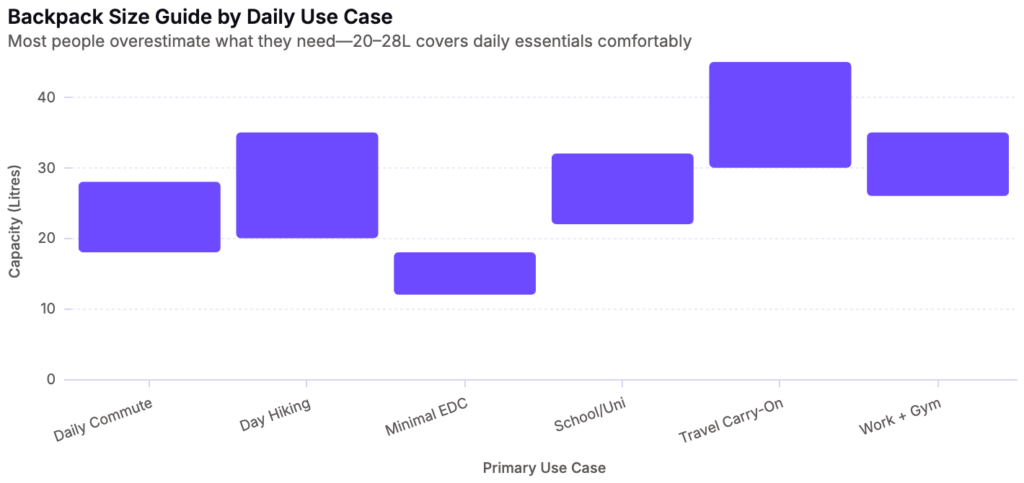
    Backpack Size Guide by Daily Use Case: Most people overestimate what they need—20–28L covers daily essentials comfortably

    Rules of Thumb

    • Under 18L: Minimalist everyday carry (EDC). Phone, wallet, keys, tablet, light jacket, water bottle. Great for urban life when you’ve embraced minimalism.
    • 20–28L: The sweet spot for most people. Fits a laptop, lunch, change of clothes, water bottle, and miscellaneous essentials without becoming a black hole. This is the range that transitions seamlessly from work to gym to weekend hike.
    • 30–35L: Students, cyclists, and those who genuinely carry bulky items (textbooks, gym shoes, climbing gear). At this size, pay close attention to hip belt support and load-lifting straps—your shoulders alone can’t manage 30+ pounds comfortably for extended periods.
    • 40L+: Travel territory. These should have proper suspension systems (frame, padded hip belt, load lifters). If you’re carrying 40L every day, seriously evaluate whether you need to.

    The Weight Penalty Nobody Talks About

    Here’s an often-overlooked truth: a larger backpack encourages a heavier load, and the strain on your body increases nonlinearly. A 15-pound load carried on poorly designed shoulder straps for an hour causes measurable discomfort. The same weight distributed through a hip belt and frame is barely noticeable. Before sizing up, ask: Do I actually need to carry this, or am I packing out of anxiety?


    Ergonomics: Protecting Your Back, Shoulders, and Posture

    An eco-friendly backpack that destroys your posture isn’t truly sustainable—it’s just shifting environmental cost onto your body. Here’s what to look for:

    Padded, contoured shoulder straps are non-negotiable. Look for at least 15mm of closed-cell foam, shaped to follow the curve of your shoulders rather than cutting straight across. Sternum straps (the small connector across your chest) prevent straps from sliding off shoulders and improve load stability dramatically—especially when cycling or walking briskly.

    Hip belts matter more than people think, even on smaller packs. Even a lightweight webbing hip belt transfers 20–30% of load weight to your pelvis, which is structurally far better equipped to bear weight than your relatively delicate trapezius muscles.

    Back panels should provide ventilation channels to reduce sweating and have enough rigidity to prevent the pack contents from pressing unevenly against your spine. Some eco-conscious brands use recycled mesh or natural cork panels.

    Load distribution is the real ergonomic secret. Pack heaviest items closest to your spine and higher up. Lighter, bulkier items go in the outer compartments. This keeps your centre of gravity aligned and reduces the rotational torque that causes lower back pain.


    What to Look for in an Eco-Conscious Brand

    Beyond materials, the company behind your backpack matters enormously. Greenwashing is rampant in the outdoor industry—here’s a checklist for evaluating brand authenticity:

    CriteriaWhat to Look For
    Material TransparencyFull disclosure of fabric composition, lining, hardware, and coatings. If a brand hides its material specs, that’s a red flag.
    Supply ChainPublishing factory locations, fair labour certifications (Fair Trade, SA8000), and traceability programs.
    Repair ProgramsOffering replacement parts, repair services, or lifetime warranties. A brand willing to fix your bag is invested in longevity.
    Take-Back/RecyclingEnd-of-life programmes that accept old bags for recycling or upcycling rather than landfilling.
    CertificationsBluesign (chemical safety), GRS (Global Recycled Standard), GOTS (organic textile), LWG (leather working group).
    Carbon ReportingPublishing emissions data and setting reduction targets—ideally verified by third parties.

    Brands worth researching (this is not exhaustive, and you should verify current practices): 

    Patagonia (affiliate link) (longstanding environmental leadership, Black Hole bags use recycled materials, robust repair program), 

    Fjällräven (affiliate link) (G-1000 waxed fabric, re-waxing extends life indefinitely), 

    Topo Designs (affiliate link) (some styles use recycled materials, made-in-USA options), 

    Terra Nova and Cotopaxi (affiliate link) (repurposed fabric programmes),

    and smaller artisanal makers who handcraft waxed canvas and leather packs in small batches.

    As an Amazon Associate I earn from qualifying purchases.


    Water Resistance and the Eco-Friendly Catch

    Here’s the rub that catches many sustainable shoppers: most truly waterproof backpacks rely on synthetic coatings and membranes. Polyurethane (PU) coatings, DWR (durable water repellent) treatments, and thermoplastic polyurethane (TPU) linings are all derived from petrochemicals. And the most effective waterproofing technology—expanded PTFE (the membrane in Gore-Tex)—involves fluorinated compounds that persist indefinitely in the environment (PFAS, or “forever chemicals”).

    So what’s the eco-conscious alternative for wet climates?

    Waxed canvas, as discussed, provides respectable water resistance through a natural mechanism. When rain hits waxed fabric, the wax causes water to bead and roll off. It’s not fully waterproof—sustained downpours will eventually penetrate—but it handles light to moderate rain admirably. Crucially, you can re-wax the fabric periodically (every 6–12 months depending on use), restoring its water resistance and extending its life for years or decades. This is sustainability in practice: maintenance over replacement.

    Vegetable-tanned leather offers similar natural water resistance, again requiring periodic conditioning with natural oils or waxes.

    For truly waterproof needs (commuting by bike in heavy rain, hiking in monsoon conditions), you may need to accept a hybrid approach: a natural-material backpack paired with a separate rain cover (which can be made from recycled materials and used only when needed) or dry bags inside your pack for electronics and documents.


    The Mindset Shift: Carrying Less Is the Ultimate Sustainability

    Here’s where we need to get honest. No backpack—however eco-friendly its materials—is truly sustainable if you’re using it to haul around 35 pounds of things you don’t need. The most environmentally responsible backpack decision might not be about which backpack to buy, but about how much you’re carrying and why.

    Auditing Your Essentials

    Consider doing a weekly “pack audit.” Empty your bag completely and sort contents into three categories:

    1. Used today or will be used tomorrow – stays in the bag.
    2. Used in the past week – candidate for staying, but question whether it needs to live in your bag permanently.
    3. Hasn’t been touched in two weeks – remove it. If you need it unexpectedly, you’ll survive.

    Most people find they can remove 20–40% of their bag’s contents through this exercise. Less weight means less strain on your body, less wear on the bag (extending its life), and—paradoxically—a greater sense of readiness, because you can actually find things quickly.

    The Shared Culture Alternative

    There’s a deeper philosophical point here worth considering. Much of what we carry is motivated by a desire for self-sufficiency—”I might need this, so I’d better have it.” But in communities with strong shared infrastructure, this burden shrinks dramatically:

    • Workplaces with proper lockers eliminate the need to carry gym clothes both directions.
    • Public libraries, maker spaces, and tool libraries mean you don’t need to own—or carry—specialised equipment.
    • Community bike repair stations along commuting routes reduce the need for full tool kits.
    • Shared kitchen facilities at co-working spaces mean you don’t need to lug lunch containers, cutlery, and condiments.

    This isn’t about austerity—it’s about recognising that carrying everything yourself is a uniquely modern, individualistic assumption. Previous generations routinely relied on shared spaces and community infrastructure. Rebuilding that infrastructure, or simply tapping into what already exists, can lighten your load—literally and figuratively.

    The most resilient “grab bag” for emergencies, after all, isn’t one stuffed with every conceivable item. It’s one with the essentials—documents, medications, cash, phone charger, first aid—organised so you can grab it and go, trusting that you can access additional resources through community networks.


    Price vs Lifespan: The Real Cost Calculation

    A £40 backpack that lasts two years costs you £20/year. A £150 waxed canvas pack that lasts twelve years costs you £12.50/year. And the latter almost certainly has a lower environmental footprint per year of use.
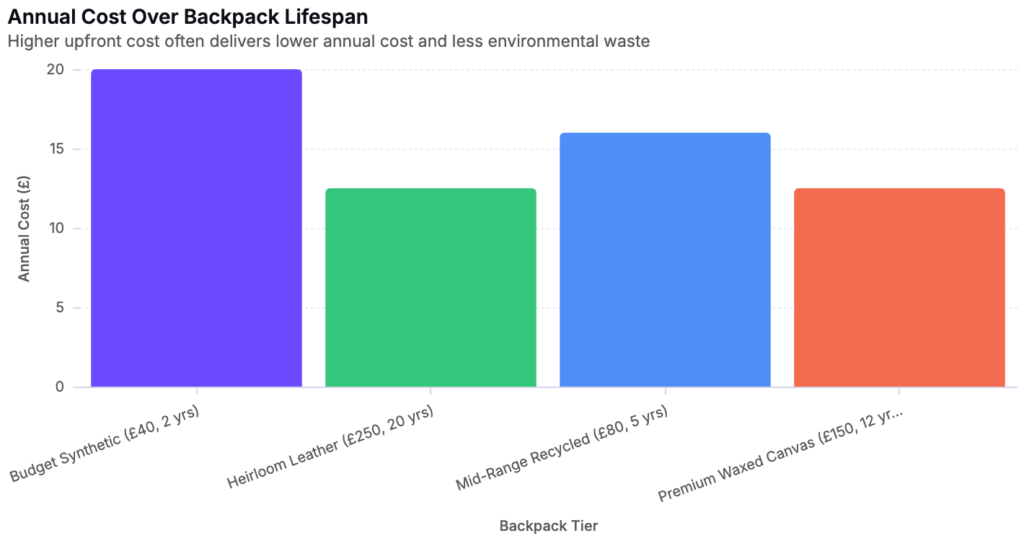

    Annual Cost Over Backpack Lifespan; Higher upfront cost often delivers lower annual cost and less environmental waste

    This isn’t to say everyone should spend £250 on a backpack. Budget constraints are real. But if you can afford the upfront investment, buying fewer, better things is both financially and ecologically smarter over time.


    Frequently Asked Questions

    Can an eco-friendly backpack be truly waterproof?

    Not fully waterproof in the way a synthetic dry bag is—but it can be highly water-resistant. Waxed canvas and vegetable-tanned leather both repel water naturally and can be re-treated periodically. For genuinely waterproof needs, pair a natural-material bag with a recycled-content rain cover or internal dry bags. The trade-off is between absolute waterproofing and material sustainability.

    How do I re-wax a waxed canvas backpack?

    You’ll need a block of wax (beeswax, paraffin, or a commercially blended wax like Fjällräven’s Greenland Wax). Apply evenly across the fabric surface, then use a hair dryer on medium heat to melt the wax into the fibres. Let it cure for 24 hours. The process takes about 20 minutes of active effort and restores water resistance for 6–12 months. It’s satisfying, meditative work—and a key reason waxed canvas lasts decades.

    Are recycled polyester backpacks actually better for the environment?

    Yes, incrementally. Producing rPET uses approximately 50–70% less energy than virgin polyester and diverts plastic bottles from landfill. However, rPET is still plastic—it sheds microplastics, doesn’t biodegrade, and is rarely recyclable at end of life. It’s harm reduction, not a complete solution. If your priority is maximum sustainability, natural materials remain preferable; if you need high performance and water resistance, rPET is a reasonable compromise.

    What’s the ideal capacity for someone who bikes to work and hikes on weekends?

    Look for a 24–30L pack with compression straps. Compression lets you cinch the bag down for commute loads (looking sleek and reducing sway while cycling) and expand it for weekend trails. Prioritise a sternum strap (critical for cycling stability) and consider a removable hip belt. A waxed canvas or rPET body with a ventilated back panel is ideal.

    Is leather ethical?

    This is genuinely complex and depends on your ethical framework. Vegetable-tanned leather is a byproduct of the meat industry—if you consume dairy or meat, the leather exists regardless of whether you buy it. Full-grain, veg-tanned leather is biodegradable and can last 20+ years, making its per-year environmental impact very low. However, chrome tanning (the dominant method globally) is highly polluting, and some people object to leather on principle regardless of sourcing. If you choose leather, seek out vegetable-tanned, full-grain hides from tanneries with environmental certifications.

    How can I make my current backpack last longer?

    Empty it fully each week and shake out debris. Spot-clean stains rather than machine washing (which damages coatings and shortens fibre life). Store it unzipped in a dry place to prevent mould. Replace worn zipper pulls before zippers fail. Apply seam sealer to high-stress seams annually. If a strap or buckle breaks, contact the manufacturer—many offer repair services or sell replacement parts. Every year of extended life is a year of avoided manufacturing impact.

    What about vegan leather backpacks—are they eco-friendly?

    It varies enormously. Piñatex (pineapple leaf fibre) and cork are promising biodegradable options with relatively low impact. However, many “vegan leather” products are actually polyurethane-coated fabric—essentially plastic with a marketing-friendly name. These shed microplastics and don’t biodegrade. If you’re choosing vegan leather for environmental reasons (rather than ethical ones), scrutinise the specific material carefully.


    Final Thoughts: Buy Once, Carry Mindfully

    The most sustainable backpack is the one you already own, used thoughtfully and maintained with care. If you’re in the market for a new one, the hierarchy of environmental preference generally runs: repair your current bag → buy a high-quality used bag → invest in a durable natural-material pack → choose recycled synthetics → avoid virgin synthetic fast-fashion packs.

    Within that framework, the ideal purchase for most people looks something like this: a 20–28L waxed canvas or high-recycled-content backpack, with proper shoulder strap padding, a sternum strap, and enough organisational pockets to keep essentials accessible without encouraging hoarding. Something that looks good on a train platform and on a forest trail. Something that can be repaired, re-waxed, and re-loved for a decade or more.

    Because the real luxury in a chaotic world isn’t having everything with you—it’s knowing that what you have is enough, and that the bag on your back wasn’t bought at the planet’s expense.


    Have a question about eco-friendly backpacks that we didn’t cover? Drop a comment below, and we’ll update this guide as new materials, brands, and innovations emerge.

  • The Ultimate Walking Shoes Buying Guide: Affordable Footwear for Lifelong Health and Accessibility

    Introduction

    In a world of increasingly expensive fitness trends, high-tech gym memberships, and equipment-heavy sports, walking stands out as a refreshing exception. It requires no special membership, minimal gear, and can be enjoyed by virtually anyone with mobility. The health benefits are well-documented: studies consistently show regular walking improves cardiovascular health, aids weight management, boosts mental wellbeing, and can extend lifespan.

    Yet many people overlook walking because they believe their footwear isn’t suitable. The wrong shoes can turn a pleasant walk into a painful ordeal, leading to blisters, joint strain, and eventual abandonment of the activity altogether. Conversely, investing in proper walking shoes can unlock years of accessible exercise.

    This comprehensive guide addresses exactly that gap. Whether you’re a senior looking for comfortable daily walkers, a parent seeking budget-friendly options for family walks, or someone recovering from injury who needs supportive footwear, this guide will help you navigate the crowded market of walking shoes and find the perfect pair for your needs.


    Why Walking Shoes Matter More Than You Think

    The Science Behind Proper Footwear

    Walking may seem simple, but each step involves approximately 20 muscles working together. Your feet absorb forces equivalent to 1-1.5 times your body weight with every stride. Without proper support, these forces travel up through your ankles, knees, hips, and spine, potentially causing chronic pain over time.

    Proper walking shoes provide:

    • Cushioning: Reduces impact stress on joints
    • Arch support: Maintains natural foot alignment
    • Heel stability: Prevents excessive rolling inward or outward
    • Breathability: Keeps feet dry and prevents fungal infections
    • Traction: Reduces slip-and-fall risk on varied surfaces

    Who Benefits Most from Quality Walking Shoes?

    DemographicPrimary BenefitKey Shoe Features Needed
    Seniors (65+)Fall prevention, joint protectionWide toe box, strong heel counter, easy closures
    People with diabetesCirculation protection, pressure distributionSeamless interior, extra depth, diabetic-approved
    Overweight individualsImpact reduction, arch supportMaximum cushioning, motion control, durable outsole
    Flat-footed walkersPronation controlStability features, firm midsole, structured arch
    High-arched walkersShock absorptionFlexible sole, generous cushioning, neutral support
    Plantar fasciitis sufferersHeel pain reliefHeel cup, arch support, rigid shank
    Budget-conscious buyersValue without sacrificing healthMid-range brands, versatile models, durability

    Understanding Walking Shoe Categories

    Not all “walking” shoes are created equal. The market has become flooded with products using the term loosely. Here are the main categories:

    1. Dedicated Walking Shoes

    Specifically engineered for walking mechanics. These typically have:

    • Rocker sole geometry to facilitate the heel-to-toe rolling motion
    • Softer cushioning than running shoes (walking generates less impact but more repetitive motion)
    • Flex grooves at the ball of the foot for natural movement
    • Often lighter construction than athletic sneakers

    2. Running Shoes Used for Walking

    Many people successfully walk in running shoes, which offer:

    • Superior cushioning for joint protection
    • Excellent durability for high-mileage walking
    • Strong arch support systems
    • Drawbacks: may be overly stiff, too aggressive tread for pavement, higher cost

    3. Athletic Sneakers (Cross-Trainers)

    General-purpose athletic shoes that work for walking plus other activities:

    • Versatile for mixed workouts
    • Moderate cushioning and support
    • Often better value if you do multiple activities
    • Compromise: may not excel at any single purpose

    4. Orthopedic/Therapeutic Walking Shoes

    Medical-grade footwear for specific conditions:

    • Prescription-adjacent designs
    • Accommodate custom orthotics
    • Extra width and depth options
    • Higher cost, often insurance-covered with documentation

    5. Budget Walking Shoes

    Entry-level options under $60:

    • Basic cushioning and support
    • Suitable for occasional walkers
    • Limited durability (typically 300-400 miles)
    • Good starting point for beginners unsure of commitment

    Essential Features to Evaluate

    Cushioning Systems

    Different materials serve different needs:

    EVA Foam: Lightweight, moderately cushioned, common in budget shoes. Good for casual walkers.

    Polyurethane: Denser, more durable, lasts longer but heavier. Ideal for overweight walkers or those needing maximum support.

    Gel/Cushion Inserts: Brand-specific technologies (like ASICS Gel or Brooks DNA Loft). Premium comfort, higher price point.

    Air Chambers: Nike Air or similar. Responsive feel, good energy return, variable durability.

    Recommendation: Try before you buy. Walk around the store for several minutes. If you feel hard spots or uneven pressure, move to another model.

    Arch Support Types

    Arch TypeCharacteristicsBest Support Level
    Low/FlatEntire foot touches groundMotion control/stability
    NormalMidfoot visible but partial contactNeutral/mild stability
    HighOnly heel and forefoot touch groundMaximum cushioning/flexible

    Heel Counter Design

    The heel counter is the rigid cup at the back of the shoe that stabilizes your heel. A quality heel counter:

    • Should be firm enough to hold its shape when squeezed
    • Should not dig into your Achilles tendon
    • Should prevent side-to-side heel wobble

    Test it by gripping the shoe and twisting gently. Minimal flex indicates good construction.

    Toe Box Space

    Your toes need room to spread naturally during the walking gait. A cramped toe box causes bunions, hammertoes, and neuromas over time.

    Measurement guideline: You should have roughly a thumb’s width of space between your longest toe and the shoe’s end. Consider sizing up half a size if between sizes.

    Outsole Traction Patterns

    Pavement walking: Smooth or lightly textured rubber outsoles perform best and wear evenly on hard surfaces.

    Trail/incline walking: Deeper lugs and multidirectional patterns provide grip on dirt, gravel, and wet surfaces.

    Mixed terrain: Hybrid tread patterns work adequately on both surfaces, though compromise slightly on each.


    Top Walking Shoe Brands Compared

    While specific models change frequently, brand philosophies remain relatively consistent. Here’s an overview of major players in the walking shoe market:

    Brand
    (affiliate links)
    Price RangeBest ForNotable TechnologyDurability Expectation
    Brooks (affiliate link)$$-$$$Serious walkers, runners who walkDNA Loft cushioning, GuideRails support400-500 miles
    ASICS (affiliate link)$-$$$Flat-footed walkers, plantar fasciitisGel cushioning, Dynamic DuoMax support350-450 miles
    New Balance (affiliate link)$-$$$Wide feet, diabetics, seniorsFresh Foam, multiple width options300-400 miles
    Skechers (affiliate link)$-$$Budget-conscious, casual walkersMemory Foam insoles, Slip-ins200-300 miles
    Hoka One One (affiliate link)$$-$$$Maximum cushioning, joint protectionOversized midsole, Meta-Rocker300-400 miles
    Altra (affiliate link)$$-$$$Natural foot shape, zero-drop preferenceFootShape toe box, Zero Drop platform250-350 miles
    Vionic (affiliate link)$$-$$$Orthotic support, podiatrist-designedBuilt-in orthotic footbed250-350 miles
    ECCO (affiliate link)$$-$$$$European fit, leather constructionHYDROMAX moisture-wicking400+ miles

    Note: Mileage estimates vary dramatically based on weight, walking surface, gait, and care.

    As an Amazon Associate I earn from qualifying purchases.


    Budget-Friendly Options That Don’t Compromise Health

    Quality footwear shouldn’t break the bank. Many affordable options provide adequate protection for average walkers. Here’s how to maximize value:

    What You Can Sacrifice (Budget Category)

    • Cutting-edge materials and proprietary technologies
    • Brand prestige and marketing-driven features
    • Latest seasonal colorways and styling
    • Extra-specialized performance characteristics

    What You Cannot Sacrifice

    • Adequate arch support matching your foot type
    • Proper sizing and toe box space
    • Heel stability and counter construction
    • Non-skid outsole appropriate for your terrain
    • Breathable upper material to prevent moisture buildup

    Best Budget Walking Shoes by Category

    NeedRecommended Model
    (affiliate links)
    Approximate Price
    Daily casual walkingSkechers GoWalk series (affiliate link)$
    Wide feet accommodationNew Balance 928v3 (affiliate link)(previous season)$-$$
    Maximum cushion on budgetReebok Floatride Energy Walk (affiliate link)$-$$
    Diabetic-friendlyPropet TravelActiv (affiliate link)$-$$
    Lightweight travelHoka Clifton 9 (affiliate link)(outlet/clearance)$$-$$$

    As an Amazon Associate I earn from qualifying purchases.

    Money-Saving Tips:

    1. Shop previous season colors/styles (often identical performance, 30-40% discount)
    2. Check outlet stores and official brand sale sections online
    3. Sign up for retailer newsletters for first-time buyer discounts
    4. Purchase mid-season when demand drops (after peak hiking/walking seasons)
    5. Consider certified refurbished or open-box options from reputable retailers

    Sizing and Fit Guidelines

    The Golden Rules

    1. Shop later in the day: Feet swell throughout the day; afternoon shopping ensures comfortable fit during walking.
    2. Wear walking socks: Bring or purchase the sock thickness you’ll use for walking to ensure proper fit.
    3. Measure both feet: One foot is often larger; fit to the larger foot.
    4. Account for swelling: Add ¼-½ inch beyond your measured length for warm-day swelling.
    5. Don’t break in extensively: Walking shoes should feel comfortable within the first few wears. Significant discomfort indicates poor fit.

    Width Considerations

    Most brands offer standard width (D for men, B for women), but many accommodate wider needs:

    Width CodeMen’sWomen’sAvailability
    NarrowAAALimited selection
    StandardDBAll models
    Wide2EDMost models
    Extra Wide4E2ESelected models
    XX-Wide6E4ESpecialty retailers

    New Balance and Brooks offer the widest range of width options among mainstream brands.

    When to Size Up vs. Stay True

    Size up if:

    • You have high-volume feet (instep sits high)
    • You plan to use custom orthotics inside the shoe
    • Your toes frequently hit the front after 30+ minute walks
    • You experience numbness in toes during activity

    Stay true if:

    • Your heel slips despite tight lacing
    • You experience blisters on heels or pinky toes
    • You feel excessive foot movement inside the shoe
    • You have narrow feet and the shoe feels loose even when tightened

    Maintenance and Replacement Schedule

    Extending Shoe Life

    1. Rotate pairs: Having 2-3 pairs extends individual shoe life significantly. Moisture has time to evaporate completely between uses.
    2. Air dry properly: Never machine dry. Stuff with newspaper to absorb moisture and maintain shape. Keep away from direct heat sources.
    3. Clean gently: Remove dirt with soft brush and mild soap. Avoid harsh chemicals that degrade adhesives and materials.
    4. Store correctly: Keep in cool, dry place away from sunlight. Plastic bags trap moisture; breathable fabric bags are ideal.

    Replacement Indicators

    Replace your walking shoes when you notice:

    • Visible compression: Midsole foam appears permanently flattened or wrinkled
    • Uneven wear patterns: Excessive wear on one side of the outsole
    • Loss of cushioning feel: Ground becomes noticeably harder through the sole
    • Upper damage: Cracks, tears, or separated seams
    • New pain points: Increased foot, knee, hip, or back pain correlating with walking sessions
    • Mileage threshold: Most shoes reach functional limit at 300-500 miles depending on construction and body weight

    Average calculator: For someone walking 2 miles daily (730 miles/year), expect annual replacement with standard shoes. Heavy walkers (4+ miles/day) may need 2 replacements yearly.


    Special Considerations

    For Diabetes

    Diabetic neuropathy reduces sensation in feet, making it difficult to detect early blister or pressure damage. Critical features include:

    • Seam-free interior to minimize friction points
    • Removable insoles for custom orthotics
    • Extra depth for accommodative fit
    • Diabetic certification from healthcare provider
    • Regular foot inspection routine even with proper footwear

    Brands with dedicated diabetic lines: New Balance, Drew Shoe, Orthofeet

    For Seniors and Fall Prevention

    As balance declines with age, footwear becomes a safety device. Prioritize:

    • Firm heel counter preventing ankle rollover
    • Non-slip outsole with proven traction ratings
    • Easy closures (Velcro or elastic) for those with arthritis
    • Low-profile design avoiding tripping hazards
    • Adequate width to accommodate foot spreading and deformities

    Recommended features: Slip-resistant certifications, rocker sole designs reducing roll risk

    For Plantar Fasciitis

    This condition causes stabbing heel pain, especially with first steps in the morning. Beneficial shoe characteristics:

    • Deep heel cup stabilizing calcaneus
    • Rigid shank preventing excessive arch flattening
    • Contoured arch support reducing ligament tension
    • Moderate heel height (not completely flat)
    • Replaceable insoles for custom orthotic insertion

    For Trail and Incline Walking

    When venturing beyond pavement:

    • Aggressive lug pattern for loose terrain traction
    • Reinforced toe cap protecting against rocks
    • Water-resistant upper for stream crossings
    • Stiffer sole providing rock plate protection
    • Ankle coverage consideration based on incline severity

    Addressing Mobility Limitations

    We must acknowledge an important limitation in walking’s accessibility. While this guide focuses on optimal footwear for those who can walk, we recognize that mobility limitations—including leg amputations, paralysis requiring wheelchairs, severe joint disease, and neurological conditions affecting lower limbs—prevent some individuals from accessing this exercise form equally.

    Alternative Exercise Options

    For those unable to walk traditionally, comparable health benefits can come from:

    • Seated walking simulations: Upper-body ergometer cycling with hand pedals
    • Wheelchair propulsion exercises: Structured pushing routines on varied terrain
    • Chair yoga and stretching: Improves flexibility, circulation, and core strength
    • Resistance band training: Builds muscle without weight-bearing requirements
    • Aquatic therapy: Water provides support while allowing movement in any capacity
    • Standing assistive devices: Parallel bars, walkers, or supportive poles for limited ambulation

    Adaptive Equipment Considerations

    Some individuals benefit from prosthetic or orthotic modifications that enable modified walking:

    • Custom prosthetics designed specifically for walking exercise
    • Bracing systems supporting weakened joints
    • Powered exoskeleton devices (emerging technology, insurance-dependent)
    • Gait training programs with physical therapists

    If mobility limitations prevent walking, consult with healthcare providers about appropriate alternatives. The health goals—cardiovascular benefit, improved mental wellness, weight management—remain achievable through adapted means.


    FAQ Section

    How often should I replace my walking shoes?

    Most walking shoes require replacement every 300-500 miles, which translates to 4-8 months for average walkers. Signs of wear include flattened cushioning, uneven outsole wear, and increased post-walk pain. Light walkers may extend use to 12 months, while heavy walkers might need quarterly replacement.

    Are expensive walking shoes worth the cost?

    Higher-priced models often feature superior materials, better durability, and more sophisticated support systems. However, the relationship between cost and benefit diminishes after approximately $120-140. Mid-range shoes ($80-110) typically provide excellent value for most walkers. Invest in premium footwear if you have specific medical conditions requiring advanced features.

    Can I use running shoes for walking?

    Yes, many people successfully walk in running shoes. Running shoes typically offer greater cushioning and durability. However, walking-specific shoes facilitate the natural heel-to-toe rolling motion better and may reduce shin splints in high-mileage walkers. Choose based on your walking intensity and comfort preference.

    What’s the difference between walking and hiking shoes?

    Hiking shoes provide stiffer construction, aggressive tread, and ankle coverage for uneven terrain. Walking shoes prioritize flexibility, lighter weight, and pavement-appropriate outsoles. Use hiking shoes only when encountering rough trails or elevation changes; stick to walking shoes for urban/suburban paths.

    Do I need separate shoes for indoor versus outdoor walking?

    Generally, no—unless you have hygiene concerns or extremely delicate flooring at home. Indoor treadmill walking may benefit from slightly softer cushioning since surfaces are uniform. Outdoor walking requires more durable outsoles and weather resistance. Many people use one versatile pair for both environments.

    How do I know if I need orthotics instead of just good shoes?

    Consult a podiatrist or orthopedic specialist if you experience persistent pain despite wearing proper footwear. Common indicators include chronic plantar fasciitis, recurrent ankle sprains, severe overpronation or supination, and diagnosed conditions like bunions or hammertoes. Custom orthotics represent an additional investment ($200-500) but may prevent costly injuries downstream.

    Are vegan walking shoes available?

    Yes, several brands now offer synthetic alternatives to leather construction. Altra, New Balance, and Brooks all produce vegan-friendly models. Materials typically include recycled polyester mesh, synthetic overlays, and rubber outsoles. Performance equals traditional materials in most cases, though break-in periods may differ slightly.

    What if my feet sweat excessively during walks?

    Look for moisture-wicking liners (merino wool blends, CoolMax fabrics) and breathable mesh uppers. Avoid waterproof membranes unless walking in wet climates—they trap internal moisture. Change socks mid-walk for extended sessions. Consider antimicrobial treatments to prevent odor and fungal growth.

    Can walking shoes help with knee pain?

    Appropriate footwear may reduce knee strain by improving alignment and shock absorption. However, knee pain often stems from multiple factors including gait abnormalities, muscle imbalances, and existing joint degeneration. Consult physical therapy for comprehensive treatment. Walking shoes serve as one component of a broader intervention strategy.

    Should I buy online or in-store?

    Try shoes on physically whenever possible to assess fit, width, and immediate comfort. Once you identify your ideal model and size, purchasing online offers cost savings and convenience. Some retailers provide free shipping and returns, mitigating fit risks. Always order from vendors with flexible return policies.


    Conclusion: Walking Is Accessible Exercise for Most

    Walking represents one of the most democratic forms of physical activity available. With proper footwear—achievable at nearly any budget level—it becomes sustainable, enjoyable, and health-promoting for decades. The key lies not in expensive equipment or exclusive facilities, but in understanding your unique needs and selecting shoes that match your physiology, walking environment, and lifestyle.

    Remember these fundamental truths:

    1. Comfort trumps fashion and marketing hype
    2. Proper fit prevents far more problems than cheap alternatives solve
    3. Regular replacement maintains protective function
    4. Listen to your body—pain indicates something needs adjustment
    5. Walking remains accessible to those with mobility; explore adaptive options when necessary

    Start your journey today. Your future self—healthier, more mobile, mentally sharper—will thank you.


    Related Reading & Resources

    • American Heart Association Walking Program Guidelines
    • Podiatric Medical Association Consumer Foot Care Guide
    • National Institute on Aging Exercise Recommendations
    • ADA Accessibility Standards for Public Walking Paths

    Disclaimer: This guide provides general information for educational purposes. Consult healthcare professionals for personalized medical advice regarding foot conditions, injuries, or exercise programs.

  • The Complete EV Battery Health Buying Guide: How to Protect, Diagnose, and Maximize Your Electric Vehicle’s Most Expensive Component

    Everything you need to know about electric vehicle battery maintenance, used EV inspection, and the future of battery technology — in one comprehensive resource.


    Table of Contents

    1. Why EV Battery Health Matters More Than Ever
    2. Understanding Battery Degradation: What Actually Happens
    3. The Fast-Charging Dilemma: Convenience vs. Longevity
    4. Driving Habits That Impact Battery Lifespan
    5. How to Evaluate a Used EV’s Battery Health
    6. Diagnostic Tools and Smartphone Apps: Your Battery Health Toolkit
    7. Newer Battery Technologies: What’s Changing
    8. When Life Happens: Practical Compromises
    9. The Rental Alternative: Outsourcing the Problem
    10. Comparison Charts
    11. FAQ Section
    12. Key Takeaways

    1. Why EV Battery Health Matters More Than Ever

    Electric vehicle adoption has surged dramatically over the past few years, with global sales climbing year over year. Yet the conversation around how to properly care for an EV battery has not kept pace with the rate of new drivers entering the space. Unlike a gas-powered vehicle, where the engine can be serviced, repaired, and rebuilt incrementally over its lifespan, the battery pack in an EV represents a single, monolithic component that can account for 30% to 50% of the vehicle’s total value. When that component degrades significantly — or fails — the financial implications are substantial.

    According to Kelley Blue Book, consumers can expect to pay anywhere from $4,000 to $36,000 for a replacement EV battery pack, not including labor, when the battery warranty doesn’t cover the vehicle. For someone buying a used EV at a modest price point, discovering that the battery has degraded severely could mean the vehicle is worth less than the cost of repair.

    The good news? According to data analyzed by Geotab from over 22,700 electric vehicles across 21 different models, modern EV batteries are robust and generally built to last beyond a typical vehicle’s service life — but with significant variability depending on how the vehicle has been used, charged, and stored. Their earlier study of 10,000 EVs found an average degradation rate of approximately 2.3% per year, and their broader analysis suggests that with careful management, EV batteries can potentially last 20+ years.

    This guide is designed to give you — whether you already own an EV or are shopping for a used one — a practical, thorough understanding of battery health, the tools available to monitor it, and the realistic trade-offs involved in daily EV ownership.


    2. Understanding Battery Degradation: What Actually Happens

    Every time you charge and discharge an EV battery, you’re putting it through a “cycle.” Over time, these cycles cause chemical and physical changes inside the battery cells that reduce their ability to hold energy. This is called degradation, and it manifests in two primary ways:

    • Capacity fade: The battery holds less energy, meaning reduced driving range.
    • Power fade: The battery delivers power less efficiently, which can affect acceleration and overall performance.

    Several factors accelerate degradation:

    State-of-Charge Extremes: Routinely charging to 100% or letting the battery drop to near 0% puts stress on lithium-ion cells. Most manufacturers and battery experts recommend keeping the state of charge (SOC) between 20% and 80% for everyday use, reserving full charges for long trips where maximum range is needed.

    Temperature: Extreme heat is particularly damaging to battery chemistry. Prolonged exposure to high ambient temperatures accelerates chemical reactions that break down the battery’s internal components. Extreme cold, while less permanently damaging, can temporarily reduce range and charging efficiency. Storing the vehicle in a garage or shaded area can help mitigate temperature-related stress.

    Time: Batteries degrade even when sitting unused — this is called calendar aging. A vehicle stored in a hot climate at 100% charge will degrade faster than one stored in a temperate climate at 50-60% charge.

    According to the U.S. Department of Energy’s National Renewable Energy Laboratory, modern EV batteries are expected to last 12 to 15 years in moderate climates and between 100,000 and 200,000 miles, depending on usage patterns, climate, and charging habits.


    3. The Fast-Charging Dilemma: Convenience vs. Longevity

    DC fast charging (also known as Level 3 or DCFC) is one of the most convenient features of modern EV ownership. It can bring a battery to 80% in as little as 20 to 45 minutes, making long-distance travel feasible. However, the trade-off is real.

    Fast charging pushes large amounts of electrical current into the battery in a short period, generating heat and causing mechanical stress within the cells. Geotab’s research from their 22,700-vehicle dataset revealed that vehicles with high reliance on DC fast charging (more than 12% of charging sessions) showed measurably higher degradation rates than those that relied primarily on Level 1 or Level 2 charging.

    Most modern EVs have built-in safeguards — they automatically reduce charging speeds when the battery gets hot or approaches full capacity, and many employ thermal preconditioning systems to prepare the battery before fast charging. But these safeguards don’t eliminate the cumulative impact of frequent high-power charging.

    Practical Guidance:

    • Use Level 1 (standard household outlet) or Level 2 (240V home charger) for your daily charging needs.
    • Reserve DC fast charging for road trips and time-sensitive situations.
    • When you do fast charge, stop at 80% — the charging rate slows dramatically anyway, and that final 20% generates the most heat.
    • Use your vehicle’s “precondition battery” feature (available on many EVs) before arriving at a fast charger, which brings the battery to an optimal temperature for accepting a fast charge efficiently.

    4. Driving Habits That Impact Battery Lifespan

    It’s not just how you charge — it’s also how you drive.

    Aggressive Acceleration: Electric motors deliver instant torque, which is one of the joys of EV ownership. However, frequent hard acceleration draws massive current from the battery in bursts, generating heat and stressing the cells. Smooth, gradual acceleration reduces this strain. Many EVs offer an “Eco” mode that limits power output and throttle response — using it for everyday driving can meaningfully reduce battery wear over time.

    Heavy Loads and Towing: Hauling heavy cargo or towing puts sustained high demand on the battery, increasing discharge rates and heat generation. If you regularly tow or carry heavy loads, expect somewhat faster degradation and reduced range per charge.

    High-Speed Driving: Driving at highway speeds or above significantly increases energy consumption due to aerodynamic drag. While this doesn’t directly damage the battery, it means more frequent charging cycles, which cumulatively contribute to degradation.

    Regenerative Braking: One advantage of EVs is regenerative braking, which recovers energy during deceleration. Using regenerative braking effectively — rather than hard mechanical braking — can improve efficiency and reduce the number of charging cycles needed.


    5. How to Evaluate a Used EV’s Battery Health

    Buying a used EV can be an excellent value proposition — depreciation has already taken its biggest bite, and many EVs on the used market still have years of warranty remaining. But the battery is the wildcard. A vehicle that looks pristine on the outside may have a battery pack that has been degraded by poor charging habits, extreme climate exposure, or neglect.

    Here’s what to look for when evaluating a used EV:

    Dashboard Indicators

    Most modern EVs display some form of battery health information on the dashboard or infotainment screen. This might be expressed as a percentage of original capacity, a range estimate, or a battery condition indicator. However, these readings vary widely by manufacturer — some are transparent and precise, others are vague or optimistic.

    Manufacturer Service Reports

    Many dealerships and manufacturer service centers can generate a detailed battery health report upon request. If you’re buying from a dealership, ask for this document. If buying privately, you could offer to split the cost of a diagnostic service visit.

    OBD-II Diagnostic Scanning (The Gold Standard)

    The most thorough way to assess a used EV’s battery health is to use an OBD-II diagnostic tool paired with a smartphone app. This gives you access to data that the dashboard may not show, including:

    • State of Health (SOH): The battery’s remaining capacity as a percentage of its original capacity.
    • Individual cell voltages: Imbalances between cells can indicate problems.
    • Charge cycle count: How many full charge/discharge cycles the battery has been through.
    • Temperature history: Whether the battery has been exposed to extreme temperatures.
    • Rapid charge count: How many times DC fast charging has been used.

    Services Like Recurrent

    Recurrent Auto offers ongoing battery health monitoring and reporting for EV owners in the United States. Their platform connects to your vehicle and provides monthly reports on battery health, range, and charging habits. If the seller is a Recurrent subscriber, you may be able to review historical battery health data — an invaluable resource when assessing a used purchase.


    6. Diagnostic Tools and Smartphone Apps: Your Battery Health Toolkit

    The accessibility of consumer-grade diagnostic tools has democratized EV battery health monitoring. Here’s what’s available:

    Hardware: OBD-II Adapters

    These small Bluetooth or Wi-Fi dongles plug into your vehicle’s OBD-II port (typically located under the steering column) and communicate with your smartphone. Popular options include:

    DevicePrice RangeConnectivityNotes
    OBDLink MX+$80–$100BluetoothBroad compatibility, reliable performance
    OBDLink CX$60–$80Bluetooth 5.1Optimized for certain brands (BMW/MINI)
    Veepeak$25–$40Bluetooth/Wi-FiBudget-friendly, decent compatibility
    Generic ELM327$15–$25Bluetooth/Wi-FiCheapest option, variable reliability

    Software: Smartphone Apps

    AppPlatformBest ForCost
    Car Scanner ELM OBD2 ProiOS / AndroidUniversal EV diagnostics; shows SOH%, cell voltages, charge cycles, temperature historyFreemium
    OBD FusioniOS / AndroidAdvanced battery metrics, customizable dashboardsPaid
    Scan My TeslaiOS / AndroidDedicated to Tesla vehiclesPaid
    EV WatchdogAndroidBrand-specific diagnostics for Kia/HyundaiFreemium
    AlphaOBDAndroidQuick health estimates for various EVsFree
    EVScanneriOSQuick battery health checks, useful for used-EV shoppingFree (with OBD adapter)

    How to Set Up and Use These Tools

    1. Locate the OBD-II port — usually under the dashboard on the driver’s side.
    2. Plug in the adapter — it’s safe to leave it installed permanently if desired.
    3. Download your chosen app and pair it with the adapter via Bluetooth or Wi-Fi.
    4. Turn on the vehicle (some data requires the car to be “ready” or even driven briefly).
    5. Select your vehicle make and model within the app.
    6. Review the data — focus on SOH%, cell voltage balance, and charge cycle count.

    This process takes about five minutes and can save you thousands of dollars when buying a used EV.


    7. Newer Battery Technologies: What’s Changing

    If you’re shopping for a newer EV — or planning to keep one for a decade or more — it’s worth understanding the battery technology landscape, as different chemistries behave differently under stress.

    Lithium Iron Phosphate (LFP)

    LFP batteries have become increasingly common in mass-market EVs, used by manufacturers like Tesla, Ford, and BYD. Their key advantages:

    • Longer cycle life: Often exceeding 2,000–3,000 full-depth cycles
    • Better safety profile: More thermally stable, less prone to thermal runaway
    • Lower cost: No cobalt or nickel, reducing material expenses
    • Tolerance for full charging: Can be charged to 100% more frequently without the same degradation concerns as NMC chemistry

    The trade-off is lower energy density, meaning LFP packs are heavier and bulkier for the same capacity — which can translate to slightly shorter range.

    Nickel Manganese Cobalt (NMC) / Nickel Cobalt Aluminum (NCA)

    These are the more traditional lithium-ion chemistries used in many longer-range EVs. They offer higher energy density (more range per unit of weight) but are more sensitive to temperature and benefit from the 20–80% charging rule.

    Solid-State Batteries (Emerging)

    Often described as the “holy grail” of EV battery technology, solid-state batteries replace the liquid electrolyte found in conventional lithium-ion cells with a solid material. Benefits promised include:

    • Higher energy density (longer range in a smaller, lighter package)
    • Improved safety (elimination of flammable liquid electrolyte)
    • Faster charging potential with less heat generation
    • Longer lifespan

    Prototypes have shown promising results — including LFP solid-state packs that continued functioning after being physically cut open. However, widespread commercialization for mass-market EVs is still likely several years away, with some industry observers suggesting affordable solid-state EVs won’t reach dealer lots for 5–10 years.

    Advanced Battery Management Systems (BMS)

    Regardless of chemistry, modern EVs increasingly employ sophisticated battery management systems that use AI-driven monitoring, active cooling, and even phase-change materials to keep cell temperatures within a narrow, optimal range. CATL’s Shenxing Pro, for example, was unveiled as the world’s first LFP battery with 5C-class fast charging capability, achieved through nano-engineered cathode particles, optimized electrolytes, and a redesigned BMS architecture.

    The practical takeaway: newer EVs generally have more resilient battery packs than those from even five years ago, thanks to both chemistry improvements and smarter management systems.


    8. When Life Happens: Practical Compromises

    Here’s the honest reality of EV ownership: sometimes you need to fast charge. Sometimes you need to floor it to merge onto a highway. Sometimes you’re hauling a load, driving across the country, or caught in extreme weather. Perfect battery care isn’t always possible — and that’s okay.

    The goal isn’t perfection; it’s consistency over time. Here’s how to think about it:

    The 80/20 Rule of Battery Care: If you follow best practices 80% of the time — mostly Level 2 charging, keeping SOC between 20–80%, smooth driving, parking in shade — the occasional fast charge, hard acceleration, or 100% charge for a road trip will have a negligible impact on long-term battery health. Battery degradation is cumulative; isolated incidents don’t move the needle the same way daily habits do.

    Seasonal Adjustments: In winter, your range will drop regardless of what you do. It’s fine to charge to 100% and use fast charging more frequently during cold months — just return to gentler habits when temperatures moderate.

    Long Trips: Road trips are exactly what DC fast charging is designed for. Use it freely when traveling, then return to home charging habits when you’re back. Many EV owners take several long trips per year without measurable impact on battery health.

    Towing and Heavy Loads: If you regularly tow or haul, you may see somewhat faster degradation. Factor this into your expectations and, if possible, choose an EV with a larger, more robust battery pack rated for towing duty.


    9. The Rental Alternative: Outsourcing the Problem

    For drivers who occasionally need an EV for demanding use cases — long road trips, heavy hauling, or high-mileage weeks — but want to minimize wear on their own vehicle’s battery, rental and car-sharing services offer an alternative.

    Services like Zipcar, Turo, and traditional rental companies increasingly offer EV options. The appeal is straightforward:

    • You get the benefit of an electric vehicle for a specific trip without putting mileage, fast-charge cycles, or heavy-load stress on your battery.
    • Rental EVs are maintained by the fleet operator, who handles battery health management (or doesn’t — but that becomes their problem, not yours).
    • You can choose a vehicle suited to the task — a larger EV for a family trip, a truck for hauling, a long-range model for interstate travel.

    The trade-off is cost. Rental and sharing services carry a premium compared to driving your own vehicle. Daily rates, mileage fees, and insurance costs add up quickly. For occasional use, however, the math can work out favorably when compared to accelerated battery degradation on a vehicle you own outright.

    This approach is particularly worth considering if:

    • Your daily driving is modest (short commutes, errands) but you take a few demanding trips per year.
    • You own an EV with a smaller battery pack and want to avoid excessive fast charging on long journeys.
    • You’re deciding between a cheaper short-range EV and a more expensive long-range one — the rental option lets you bridge the gap.

    10. Comparison Charts

    Chart 1: Charging Methods and Their Impact on Battery Health

    Charging MethodSpeedHeat GenerationImpact on Battery HealthBest For
    Level 1 (120V household)~3–5 miles of range/hourMinimalLowest impactOvernight top-ups, plug-in hybrids
    Level 2 (240V home/work)~25–35 miles of range/hourLowVery low impactDaily charging, primary method
    DC Fast Charging (Level 3)~80% in 20–45 minHighModerate-to-high with frequent useRoad trips, time-sensitive charging

    Chart 2: EV Battery Chemistries Compared

    FeatureLFPNMC/NCASolid-State (Future)
    Energy DensityLowerHigherHighest (projected)
    Cycle Life2,000–3,000+ cycles1,000–2,000 cyclesTBD (expected superior)
    SafetyExcellentGoodExcellent (projected)
    CostLowerHigherHigher (initially)
    Full Charge ToleranceCan charge to 100% routinelyBest kept at 80%TBD
    Fast-Charging ResilienceImproving rapidlyModerateExpected excellent
    Commercial AvailabilityWidely availableWidely availableLimited/prototyping

    Chart 3: Diagnostic Tool Quick Reference

    Tool/ServiceTypeCostBest Use Case
    Dashboard readoutBuilt-inFreeQuick daily check
    Dealer service reportProfessional$0–$150Pre-purchase inspection
    Car Scanner ELM OBD2 Pro + OBD dongleDIY$25–$100 totalComprehensive self-diagnosis
    Recurrent AutoSubscription serviceFree–monthly feeOngoing monitoring, used-EV reports
    OBD Fusion + OBD dongleDIY$10–$15 app + dongleAdvanced users wanting custom data views

    Chart 4: Own vs. Rent — When Does Each Make Sense?

    FactorOwn an EVRent an EV
    Daily commute (<50 mi)✅ Ideal❌ Overkill
    Weekly long trips✅ Manageable with planning⚠️ Costly long-term
    Occasional road trips (2–4x/year)✅ Fine with occasional fast charging✅ Consider renting instead
    Regular towing/hauling✅ Choose an EV rated for it✅ Rent a capable EV for heavy jobs
    Short urban trips only✅ Perfect fit❌ Unnecessary
    Budget sensitivity✅ Lower cost per mile⚠️ Premium for flexibility

    11. Frequently Asked Questions

    Q: How long do EV batteries actually last?

    According to the U.S. Department of Energy, modern EV batteries typically last 12 to 15 years in moderate climates and between 100,000 and 200,000 miles. Geotab’s research analyzing 22,700 vehicles suggests that with careful management, some EV batteries can remain road-capable for 20+ years. Degradation is gradual — you’ll see a slow reduction in range over time, not a sudden failure.

    Q: Should I charge my EV to 100% every night?

    For most EVs with NMC or NCA battery chemistry, the recommendation is to charge to 80% for daily use and reserve 100% charges for when you need maximum range. If your EV uses LFP chemistry (common in many newer Teslas, Ford Mustang Mach-E standard range, and others), the manufacturer may permit routine 100% charging — check your owner’s manual.

    Q: How much does it cost to replace an EV battery?

    Kelley Blue Book reports that replacement costs range from approximately $4,000 to $36,000, depending on the vehicle, battery size, and chemistry. This typically does not include labor. Most EV batteries are covered under warranty for 8–10 years or 100,000–150,000 miles.

    Q: Will fast charging ruin my battery?

    No — occasional fast charging will not ruin your battery. Modern EVs have thermal management systems that protect the pack during fast charging. However, frequent fast charging (more than about 12% of your charging sessions, according to Geotab’s data) can measurably accelerate degradation over time. Use Level 2 charging as your primary method and reserve fast charging for when you truly need it.

    Q: Can I check battery health before buying a used EV?

    Yes — and you absolutely should. You can use an OBD-II Bluetooth adapter (available for $25–$100) paired with a smartphone app like Car Scanner ELM OBD2 Pro, OBD Fusion, or EVScanner to read the battery’s State of Health percentage, cell voltages, charge cycle count, and rapid-charge statistics. Alternatively, ask the seller for a dealer service report or check if they have a Recurrent Auto subscription with historical data.

    Q: What is “State of Health” (SOH)?

    SOH is a metric expressing the battery’s current usable capacity as a percentage of its original capacity. A battery with 90% SOH can store 90% of the energy it could when new. This is the single most important number to look at when evaluating a used EV’s battery.

    Q: Does cold weather damage EV batteries?

    Extreme cold temporarily reduces range and charging speed but typically doesn’t cause permanent damage — especially if the vehicle has a thermal management system and is kept plugged in so the battery can maintain optimal temperature. Extreme heat is more concerning for long-term battery health.

    Q: Are newer EVs better at managing battery health?

    Generally, yes. Advances in battery chemistry (particularly LFP), more sophisticated battery management systems with AI-driven monitoring, improved thermal management using active cooling and phase-change materials, and smarter charging protocols all contribute to better longevity in newer vehicles.

    Q: Should I leave my EV plugged in when not in use?

    In most cases, yes — especially in extreme weather. When plugged in, the EV’s thermal management system can draw power to maintain the battery at an optimal temperature. Just ensure your charge limit is set appropriately (usually 80% for daily use). Always consult your owner’s manual for manufacturer-specific guidance.

    Q: Is it worth buying a used EV, or should I wait for newer battery technology?

    Used EVs can be excellent values, particularly if the battery health checks out and the vehicle is still under its battery warranty. Newer battery technologies like solid-state cells are promising but still years away from mass-market affordability. If your driving needs are well-served by today’s EVs, waiting may not be necessary. The key is doing your homework on the specific vehicle’s battery health before purchasing.


    12. Key Takeaways

    1. Battery health is the single most important factor in EV ownership economics. At 30–50% of vehicle value, the battery demands attention and care.
    2. Daily habits matter most. Keeping your charge between 20–80%, using Level 2 charging as your primary method, driving smoothly, and protecting the vehicle from extreme heat are the four highest-impact actions you can take.
    3. Fast charging isn’t the enemy — frequency is. Occasional DC fast charging is perfectly fine. The issue arises when it becomes a regular habit rather than an exception.
    4. Never buy a used EV without checking battery health. An OBD-II adapter and smartphone app costing under $100 can reveal the battery’s true condition in minutes — potentially saving you thousands.
    5. Battery technology is improving rapidly. LFP chemistry, advanced BMS systems, and emerging solid-state technology are making newer EVs more resilient. But even today’s batteries, properly cared for, can last well over a decade.
    6. Perfection isn’t required — consistency is. Life happens. The occasional road trip, fast charge, or heavy load won’t doom your battery. What matters is the pattern over months and years.
    7. Renting can be a strategic tool. For occasional demanding use cases, renting an EV lets you preserve your own vehicle’s battery health for a known cost premium — a trade-off worth calculating.

    Disclaimer: This guide is intended for general educational purposes. Always consult your vehicle’s owner’s manual and your manufacturer’s specific recommendations for battery care. Battery technology and best practices continue to evolve.

  • The Complete Bikepacking Buying Guide: Reclaiming Your Freedom on Two Wheels

    Your essential roadmap to affordable, connected travel

    in an era of expensive, disconnected tourism


    Table of Contents

    1. Introduction: Why Bikepacking Matters Now
    2. What Is Bikepacking?
    3. The Economic Case for Bikepacking
    4. Essential Equipment Categories
    5. Comparison Chart: Bike Types for Bikepacking
    6. Gear Selection by Trip Length
    7. Electric Bicycles: A Practical Alternative?
    8. Navigation and Technology
    9. Safety Considerations
    10. Budget Breakdown and ROI
    11. Frequently Asked Questions
    12. Conclusion: Your Journey Begins

    1. Introduction: Why Bikepacking Matters Now

    Travel has become prohibitively expensive. Leisure activities increasingly demand significant financial investment and energy consumption. Parks overflow with visitors arriving in gas-burning vehicles. Urban spaces grow congested as car-centric infrastructure dominates our cities and countryside alike. This speed-based approach to movement severs the individual from the landscapes traversed—you arrive at destinations but never truly experience the journey between.

    Bikepacking offers an antidote to this disconnection. By combining bicycle touring with backpacking principles, bikepacking enables extended self-propelled adventures that prioritize accessibility, affordability, and genuine environmental engagement. Riders can traverse terrain inaccessible to conventional vehicles, reaching remote trails, rural communities, and natural areas that remain hidden from highway-dependent travelers.

    The appeal extends beyond practical economics. Bikepacking delivers sustained physical activity integrated directly into travel itself. There’s no separation between your workout and your vacation—every pedal stroke builds fitness while advancing your exploration. More importantly, traveling at bicycle speed restores the relationship between traveler and landscape. Hills, rivers, forests, and towns unfold gradually rather than rushing past as blurs behind glass windows.

    However, bikepacking presents real tradeoffs that demand honest consideration. You exist fully exposed to weather conditions without climate-controlled protection. Every kilometer requires caloric expenditure demanding consistent fuel intake. Cargo capacity remains severely limited compared to motorized travel. Major roadways pose genuine safety risks given minimal protective infrastructure beyond helmet and visibility aids.

    Modern solutions mitigate many limitations. Electric bicycles reduce exertion requirements while preserving terrain access. Inn-to-inn itineraries boost amenities without requiring extensive gear carriage. Contemporary accessories address navigation, shelter, and power needs. But understanding these alternatives requires foundational knowledge about what bikepacking actually demands.

    This comprehensive buying guide serves as your cornerstone resource. We examine equipment categories, compare bike architectures, analyze cost structures, and address the most common questions newcomers encounter. Whether you seek weekend wilderness immersion or month-long continental traversal, the information below provides the decision-making framework necessary for informed preparation.


    2. What Is Bikepacking?

    Bikepacking merges mountain biking technique with ultralight backpacking methodology. Unlike traditional bicycle touring which employs panniers mounted to front and rear racks, bikepacking utilizes frame bags, seat packs, and handlebar rolls that attach directly to the bicycle without external hardware. This configuration maintains narrower profile dimensions enabling traversal on singletrack trails, forest service roads, and rough terrain where loaded tourers cannot negotiate.

    The discipline emerged prominently during the early 2000s as mountain bikers sought extended wilderness access beyond day-ride distances. The “Silvertour” route through Montana and Wyoming gained traction around 2005, establishing precedent for transcontinental unsupported bicycle expeditions. Organizations like Adventure Cycling Association and platforms such as Bikepackers.com subsequently mapped thousands of kilometers of designated routes worldwide.

    Three core philosophies define bikepacking culture:

    Minimalism – Carrying only essentials reduces weight and bulk, enhancing maneuverability and climbing efficiency. Multi-day trips demand careful prioritization rather than convenience-based packing.

    Self-Sufficiency – Most routes lack guaranteed services. Riders must carry food, repair capability, shelter, and water filtration without relying on towns spaced regularly along highways.

    Trail Accessibility – Bikepacking prioritizes unpaved corridors over paved roads whenever possible. Dirt roads, fire breaks, and mountain trails form the primary network rather than asphalt thoroughfares.

    Understanding these principles informs purchasing decisions throughout this guide. Equipment selection reflects ultralight priorities rather than comfort-maximization strategies common in recreational cycling.


    3. The Economic Case for Bikepacking

    Traditional travel imposes escalating costs. Airline tickets fluctuate seasonally but frequently exceed several hundred dollars round-trip for domestic flights. Hotels average $100-$250 per night depending on location and amenities. Rental cars add $50-$80 daily plus fuel expenses. Restaurants accumulate rapidly—at $15-$30 per meal, three meals daily reach $45-$90 daily totals. A week-long conventional vacation easily consumes $2,000-$4,000 for two people excluding airfare.

    Bikepacking fundamentally alters this equation. Initial equipment investment ranges from $800-$3,000 depending on starting point and quality preferences. However, recurring costs remain dramatically lower:

    Expense CategoryConventional VacationBikepacking Equivalent
    Transportation$600-$1,500 (flights/car rental)$0-$50 (maintenance/fuel for supply runs)
    Accommodation$700-$1,750 (hotels)$0-$300 (camping fees/hostels)
    Food$315-$630 (restaurants)$200-$400 (grocery stores)
    ActivitiesVariable ($0-$500)Variable ($0-$200)
    Total Week$1,615-$4,380$200-$950

    Over multiple years, equipment costs amortize significantly. A properly maintained bicycle lasts decades with periodic component replacement. The first trip represents peak expense; subsequent adventures approach minimal operational costs consisting primarily of consumables—food, water, occasional maintenance supplies.

    Beyond direct monetary savings, bikepacking mitigates hidden economic pressures. Fuel price volatility impacts conventional travel unpredictably. Health expenditures decrease through consistent daily exercise integrated into transit. Environmental damage from carbon-intensive transportation becomes personal responsibility rather than abstract externalities.

    The opportunity cost argument also favors bikepacking. Time invested equals enjoyment earned—no waiting at airports, no rental car pickup lines, no hotel check-in procedures. Departure occurs immediately upon leaving home. Return happens whenever fatigue dictates. Schedule flexibility constitutes intangible value difficult to quantify financially but deeply meaningful experientially.


    4. Essential Equipment Categories

    Successful bikepacking requires systematic equipment procurement across eight functional categories. Each category contains multiple options with varying performance characteristics, durability profiles, and price points. Prioritize reliability and repairability over marginal weight reductions unless pursuing competitive ultra-endurance racing.

    4.1 The Bicycle Itself

    Your platform determines accessible terrain and comfort thresholds. Steel frames offer vibration damping and field-repairability via brazing shops globally. Aluminum provides lighter weight with harsher ride quality and catastrophic failure modes. Carbon fiber delivers maximum stiffness-to-weight ratios but demands specialized repair facilities. Titanium combines corrosion resistance with steel-like compliance but carries premium pricing.

    Wheel diameter choices affect tire clearance and rolling characteristics. 29-inch wheels roll efficiently over obstacles but limit frame geometry compactness. 27.5-inch wheels improve maneuverability while accepting wider tires. 650b offers middle-ground optimization particularly suited to women-specific geometries and smaller riders.

    4.2 Bagging Systems

    Bikepacking bags replace conventional pannier racks. Strategic placement maintains bicycle handling balance while maximizing usable volume. Three primary mounting locations exist:

    Handlebar Roll – Stores bulky soft items like clothing layers, sleep pad, and tent body. Capacity ranges from 15-35 liters. Requires secure attachment preventing sway-induced steering interference.

    Frame Bag – Occupies triangle space within main frame structure. Ideal for dense items—tools, spare tubes, batteries, food reserves. Available full-size or partial configurations accommodating bottle cages or suspension components.

    Seat Pack – Mounts beneath saddle using rail clamps. Best suited for sleeping bag, tent poles, and emergency gear. Volume typically 10-25 liters. Longer designs compromise leg clearance during pedaling strokes.

    Additional accessories include top-tube bags for frequent-access items (snacks, phone, map), feed bags for handlebar-mounted nutrition, and fork cargo plates for expedition-scale loads.

    4.3 Shelter and Sleep System

    Weight constraints demand aggressive optimization here. Tent weights span from 1kg (ultralight single-wall) to 3kg (traditional double-wall). Single-wall designs sacrifice condensation management for mass reduction—acceptable in arid climates but problematic during humid periods. Tarp systems weigh less yet provide zero precipitation protection.

    Sleeping bags utilize either down insulation (superior warmth-to-weight ratio, loses effectiveness when wet) or synthetic fills (maintains loft when damp, heavier and bulkier). Temperature ratings indicate comfort thresholds rather than survival limits—plan 10°F colder than expected minimums for safety margin.

    Sleeping pads serve dual functions: thermal insulation preventing ground heat loss and cushioning against uneven surfaces. Closed-cell foam pads never fail but compress uncomfortably. Inflatable options maximize comfort but risk punctures—always carry patch kits.

    4.4 Water and Nutrition Management

    Carry capacity depends on route availability of refill points. Dry regions necessitate 4-6 liter minimums alongside portable filtration systems. Pump filters offer fastest flow rates but heaviest weight. Gravity sacks enable passive cleaning while cooking meals. Chemical treatments eliminate biological threats but cannot remove particulates or heavy metals.

    Food selection balances caloric density against preparation complexity. Dehydrated meals require boiling water but deliver restaurant-quality nutrition. Calorie-dense snacks like nuts, dried fruit, and energy bars minimize repackaging requirements. Avoid foods needing refrigeration on trips exceeding 48 hours unless employing ice-freeze preservation techniques.

    4.5 Clothing Strategy

    Layering systems outperform single heavy garments. Base layers manage moisture wicking away from skin. Mid-layers provide active insulation during stops. Outer shells defend against wind and precipitation. All materials should dry rapidly following rain exposure or stream crossings.

    Avoid cotton entirely—retained moisture accelerates hypothermia risk in cool conditions. Merino wool offers natural odor resistance eliminating laundry requirements. Synthetics dry faster but develop persistent smells after repeated wear.

    Footwear represents permanent decision affecting entire trip success. Stiff-soled cycling shoes optimize power transfer but struggle during hiking sections. Approach shoes compromise pedal efficiency for hiking versatility. Decide based on anticipated trail mix ratios before purchasing.

    4.6 Lighting and Power

    Darkness transforms safe paths into hazard zones regardless of familiarity. Front lights provide route illumination; rear units ensure vehicle visibility. Lumen outputs range from 200 (supplementary) to 1,500+ (primary riding light). Battery longevity varies from 2-hour maximums to 20-hour endurance modes. USB-rechargeable lithium-ion cells dominate modern selections but require compatible charging infrastructure.

    Power banks extend device operational windows. Smartphone navigation drains batteries continuously. GPS units consume moderate power with superior battery life. Solar panels enable indefinite extension if sunlight exposure remains consistent—but add weight and occupy rack space.

    4.7 Tools and Repair Supplies

    Field mechanics constitute essential skills regardless of mechanical aptitude levels. Minimum toolkit includes: multi-tool with chain breaker, tire levers, patch kit, spare tubes, mini-pump or CO2 inflator, master link pliers, chain quick-link compatible with drivetrain brand, and electrical tape for temporary fixes.

    Learn three fundamental repairs before departing: flat tire resolution, derailleur adjustment, and brake cable tensioning. Videos available freely online demonstrate proper techniques. Practice on home stand repeatedly until proficiency feels automatic.

    4.8 Navigation Hardware

    Paper maps provide fail-safe redundancy independent of battery life or signal availability. Waterproof laminated versions withstand adverse conditions. Digital applications supplement rather than replace analog backups. Devices like Garmin Edge, Wahoo Elemnt, or smartphone mounts with offline map downloads enable breadcrumb tracking along planned routes.

    Cell coverage gaps render cloud-based navigation useless. Download region maps ahead of departure verifying compatibility with offline functionality. Carry backup power sufficient for entire duration plus 20% safety buffer.


    5. Comparison Chart: Bike Types for Bikepacking

    Selecting appropriate bicycle architecture fundamentally shapes achievable experiences. Different geometries prioritize competing characteristics—speed versus stability, weight versus durability, efficiency versus versatility. Match intended terrain profiles against frame capabilities before committing to purchases.

    FeatureGravel BikeMountain Bike (Hardtail)Touring BikeAdventure/
    Enduro MTB
    Primary TerrainMixed paved/unpavedTechnical singletrackPaved roadsAggressive off-road
    Tire Clearance40-50mm2.0-2.5 inches28-35mm2.3-3.0 inches
    Gearing RangeWide (compact crank)Ultra-wide (1x drivetrain)Traditional (2x/3x)Extreme (single-ring)
    SuspensionNoneFront onlyNoneFront/rear optional
    Weight9-11 kg11-14 kg12-15 kg13-16 kg
    Price Range$1,200-$4,000$1,500-$5,000$1,800-$4,500$2,000-$7,000
    Bag CompatibilityExcellent (mount points)Moderate (limited mounts)Superior (rack bosses)Good (custom solutions)
    Speed on RoadsHighLow-ModerateVery HighLow
    Off-Road CapabilityModerate-HighExcellentPoorSuperior
    Comfort Duration3-6 hour sweet spotUnlimitedUnlimitedUnlimited

    Gravel bikes represent optimal hybrid solutions balancing road efficiency with dirt accessibility. They accept moderately wide tires improving rough surface absorption while maintaining rapid acceleration on pavement segments. Handlebar drops provide multiple hand positions reducing numbness during extended descents. Frame braze-ons accommodate cargo cages and bag straps without requiring proprietary mounting systems.

    Mountain bikes excel where technical difficulty increases. Suspension forks absorb root networks, rock gardens, and washboard surfaces protecting rider fatigue. Lower gearing conquers steep grades impossible for rigid-frame competitors. Drawbacks include increased weight penalizing climbing efficiency and reduced stability when descending at high velocities due to slack head tube angles.

    Touring bikes prioritize load-carrying capacity above all else. Extended wheelbases enhance straight-line stability when burdened with heavy panniers. Generous tire clearance prevents rub even when sidewalls bulge under pressure. Downside involves sluggish acceleration making spontaneous detours physically demanding. Primarily suited to established routes with predictable service intervals.

    Adventure/enduro mountain bikes bridge extremes combining dropper posts, long-travel suspension, and progressive geometry. These machines handle extreme backcountry situations but sacrifice efficiency proportionately. Reserve for destinations requiring serious technical competence rather than casual exploration ambitions.


    6. Gear Selection by Trip Length

    Trip duration dictates minimum viable equipment packages. Shorter outings permit luxury additions; prolonged excursions demand ruthless minimization. Apply these frameworks adjusting for personal tolerance thresholds and seasonal variations.

    Weekend Trips (2-3 Days)

    Focus on redundancy elimination. Single clothing layer suffices for controlled temperature swings. Campsite selection leans toward established campgrounds providing toilets and water taps. Food planning simplifies assuming grocery access en route. Weight target: 15-20 kg total system including bicycle.

    Week-Long Expeditions (5-7 Days)

    Introduce weather contingency gear. Rain jacket becomes mandatory despite forecast optimism. Additional protein calories buffer unpredictable meal opportunities. Sleeping bag rated 15°F colder than expected lows ensures adequate rest. Target pack weight: 20-25 kg.

    Extended Adventures (10+ Days)

    Resupply strategy supersedes pure carrying capacity. Identify towns along route capable of stocking perishables. Rotate consumable items systematically to prevent spoilage. Spare parts inventory expands—spoke wrench, brake pads, chain lubricant. Plan rest days strategically avoiding cumulative strain injuries. Target system weight: 22-28 kg maximum.

    Expedition Scale (30+ Days)

    Repair capability transitions from reactive to proactive. Patch inner tubes before complete failure occurs. Lubricate chains weekly regardless of perceived cleanliness. Wear-resistant materials justify higher upfront costs replacing cheap substitutes annually. Consider mail-drop logistics for critical replenishments. Target weight ceiling: 25-30 kg sustainable limit.

    Remember these figures assume competent packing technique. Improper load distribution increases effective effort exponentially regardless of absolute masses carried. Center gravity low near bottom bracket area whenever feasible.


    7. Electric Bicycles: A Practical Alternative?

    E-bike adoption reshapes bikepacking accessibility profoundly. Pedal-assist motors reduce physical demands opening participation demographics previously excluded by conditioning barriers. Climbing previously prohibitive grades becomes manageable. Headwind resistance diminishes substantially. Recovery times shorten allowing consecutive high-output days without exhaustion accumulation.

    Current regulatory classifications divide electric bicycles into three tiers:

    Class 1 – Pedal-assist only, max assisted speed 20 mph, no throttle Class 2 – Throttle operation permitted alongside pedal assist, 20 mph cap Class 3 – Pedal-assist up to 28 mph, throttle generally prohibited

    Most bikepacking routes remain legally navigable regardless of class designation. However, certain protected wilderness areas restrict motorized transport interpretation broadly. Research specific land management agency policies before relying on e-bike classification exemptions.

    Battery capacity defines operational range realistically. Advertised mileages often reflect ideal laboratory conditions disregarding terrain elevation, ambient temperature, payload weight, and assist level utilization. Expect 40-60 mile practical ranges per charge with moderate pedal contribution. Larger capacity cells extend this window proportionately but increase overall system mass.

    Charging infrastructure limitations constrain remote deployment. Standard outlets accommodate overnight replenishment reliably. Dedicated solar setups enable indefinite operation given consistent sun exposure—but panel weight offsets mobility advantages partially. Hybrid approaches blending town stops with supplemental solar top-offs prove most versatile.

    Cost premium warrants careful evaluation. Quality conversion kits add $800-$1,500 to existing bicycle values. Purpose-built e-gravel or e-mountain platforms command $3,000-$8,000 purchase prices. Compare against projected fuel savings, health benefits, and expanded range accessibility determining payback timelines individually.

    For individuals returning from injury recovery, managing chronic conditions, or seeking multi-generational family participation, e-bikes represent transformative enabling technologies. Pure purists may reject motor assistance philosophically—but pragmatists recognize democratizing effects expanding outdoor recreation access meaningfully.


    Digital mapping revolutionized route finding compared to legacy paper-and-compass methodologies. Yet technological dependency introduces failure vectors absent from analog equivalents. Balanced approaches combine digital convenience with analog resilience.

    Smartphone Applications

    Popular choices include Gaia GPS, Komoot, Ride with GPS, and Trailforks. Offline map downloads prevent connectivity blackouts. Track recording documents actual paths traversed for future sharing or retrospective analysis. Community-contributed route databases contain millions of pre-tested itineraries filtering by difficulty grade, surface type, and distance parameters.

    Battery conservation strategies include airplane mode activation, screen dimming, background app restriction, and periodic airplane-mode cycling. External power banks rated 10,000mAh+ sustain operation through multi-day intervals reliably.

    Dedicated GPS Units

    Garmin and Wahoo ecosystems integrate seamlessly with ANT+/Bluetooth sensor networks measuring heart rate, cadence, power output, and barometric altitude. Physical button controls operate gloved hands effectively whereas touchscreen interfaces frustrate when wet or muddy. Weatherproof construction withstands immersion incidents that destroy unprotected smartphones.

    Main drawback involves subscription dependencies. Premium features unlock via monthly payments continuing indefinitely after hardware purchase. Evaluate ongoing costs preceding acquisition decisions carefully.

    Analog Redundancy

    Physical maps occupy negligible mass relative to digital alternatives yet provide irreplaceable backup value. National Forest Service publications detail road networks accurately enough for broad orientation. Compass bearings establish directional awareness independent of magnetic declination corrections. Topographic contours reveal elevation profiles anticipating climbs before encountering them physically.

    Develop competency reading contour lines understanding slope steepness visualization techniques. Mark waypoints manually noting water sources, campsites, and bailout junctions beforehand. These skills become insurance policies when electronics malfunction unexpectedly.


    9. Safety Considerations

    Exposed vulnerability distinguishes cyclists from enclosed vehicle occupants. No crumple zones protect impact forces. Seatbelts do not restrain bodies during falls. Side mirrors provide limited situational awareness compared to 360-degree vision. Defensive riding principles become survival imperatives rather than courtesy habits.

    Roadway Risks

    High-speed traffic presents primary danger vectors. Designated bike lanes reduce collision frequencies statistically but rarely exist on rural arteries connecting bikepacking routes. Shoulder widths vary dramatically—measure clearance adequacy before committing to shoulder riding positions. Passing maneuvers occur blindly when trucks navigate curves unable seeing oncoming bicycles approaching opposite directions.

    Mitigation tactics include:

    • High-visibility apparel during daylight hours
    • LED warning lights visible from multiple angles
    • Earpiece communication devices alerting approaching vehicles audibly
    • Route planning favoring lower-volume parallel roads over shortest-distance highways
    • Group formation enabling mutual lookout responsibilities

    Remote Environment Hazards

    Wilderness isolation amplifies consequence severity when injuries occur. Cell service gaps delay emergency response coordination. Weather shifts rapidly creating flash flood scenarios or lightning storm exposures. Wildlife encounters range from nuisance to lethal depending on species encountered and reaction appropriateness.

    Preparation protocols encompass:

    • Emergency locator beacon subscriptions transmitting distress signals satellite-independent
    • Comprehensive first aid training emphasizing trauma stabilization fundamentals
    • Weather forecasting apps updating hourly predictions with severe event notifications
    • Animal behavior education identifying threat displays versus defensive posturing
    • Partner accountability ensuring someone knows itinerary details and expected return timing

    Mechanical Failures

    Stranded situations arise most frequently from preventable maintenance oversights. Chain snaps terminate powered propulsion entirely requiring improvisation or abandonment scenarios. Brake pad wear compromises stopping distances dangerously on downhill grades. Spokes fracture progressively indicating hub bearing degradation progressing toward catastrophic collapse.

    Preventative measures involve scheduled inspection routines checking spoke tension uniformity, brake rotor alignment, headset play absence, and drivetrain wear indicators before departures. Learn field-expedient repair techniques recognizing irreparable damage requiring professional intervention or rescue extraction.


    10. Budget Breakdown and ROI

    Initial investment represents singular largest expense barrier preceding trip commencement. However, depreciation curves flatten considerably compared to automobiles depreciating 15-25% annually. Properly stored bicycles retain resale values exceeding 50% even after decade-long ownership spans.

    Entry-Level Setup (~$1,500 Total)

    Used gravel bike: $800 Basic bag system: $200 Camping gear: $300 Tools/spares: $100 Lighting/navigation: $100

    This configuration enables competent participation without compromising fundamental safety margins. Component upgrades follow gradual progression as skill levels advance and route ambitions expand.

    Intermediate Configuration (~$3,500 Total)

    Mid-range new gravel/MTB hybrid: $2,000 Premium bag ecosystem: $400 Ultralight shelter/sleep: $600 Advanced lighting/GPS: $300 Maintenance kit expansion: $200

    Quality improvements manifest through enhanced comfort, reduced pack weight, and expanded capability envelopes accessing technically challenging destinations.

    Expedition-Grade Platform (~$6,000+)

    Full-suspension e-bike or titanium custom build: $4,000 Complete modular luggage system: $800 Professional-grade camping ensemble: $800 Satellite communication devices: $300 Comprehensive tool inventory: $200

    Diminishing returns accelerate at upper price boundaries. Exponential spending yields linear performance gains favoring incremental upgrades over wholesale replacements initially.

    Return on investment calculations incorporate tangible financial metrics alongside qualitative lifestyle dividends. Annual vacation budgets allocated previously fund additional trips increasing adventure frequency annually. Healthcare savings accumulate through consistent aerobic conditioning reducing medical expenditures progressively year-over-year. Time wealth expands liberating weekends from commercial entertainment consumption cycles redirecting toward self-directed exploration pursuits.


    11. Frequently Asked Questions

    Q: How much does it really cost to start bikepacking?
    A: Entry-level complete setup ranges $1,200-$1,800 including used bicycle, essential bags, basic shelter, and minimal tool collection. Gradual upgrades spread over seasons prevent overwhelming initial outlays.

    Q: Can I bikepack with kids?
    A: Absolutely. Tag-along trailers tow behind adult bikes accommodating children ages 3-10. Child-sized dedicated bikes enable independent pedaling for ages 8+. Supervision ratios matter critically—never leave young passengers unsupervised near traffic hazards.

    Q: What if I get injured during a remote trip?
    A: Carry emergency locator beacons transmitting satellite messages outside cellular coverage. Share detailed itineraries with trusted contacts including check-in schedules. Travel companions provide immediate assistance while awaiting professional rescue deployment.

    Q: Are e-bikes legal on bikepacking routes?
    A: Most public lands accept Class 1 pedal-assist bicycles indistinguishable from conventional pedals mechanically. Certain wilderness designations prohibit ALL motorized transport interpretations. Verify land management agency regulations beforehand.

    Q: How do I handle bathroom breaks solo?
    A: Follow Leave No Trace principles burying human waste six inches minimum depth 200 feet from water sources. Portable trowels facilitate digging in rocky soils. Hand sanitizer eliminates contamination risks afterward. Female riders utilize disposable feminine hygiene products requiring pack-out containment bags.

    Q: What’s the maximum safe daily distance?
    A: Average fitness riders sustain 40-60 miles daily over consecutive weeks without excessive fatigue. Elite athletes push 100+ mile days occasionally but recover requiring rest intervals. Listen to bodily signals rather than arbitrary mileage targets.

    Q: Do I need special insurance coverage?
    A: Standard homeowners/renters policies cover stolen or damaged bicycles up to policy limits. Recreational accident coverage supplements liability gaps excluding motor vehicle exclusions. Specialty cycling insurance exists offering comprehensive protections including medical evacuation.

    Q: How quickly can I learn necessary skills?
    A: Fundamental mechanical competencies require 10-15 hours practice over several weeks. Navigation reading takes similar timelines. Fitness adaptations progress steadily over months depending starting baseline condition levels. Patience prevents discouragement during inevitable learning curves.

    Q: Is bikepacking dangerous?
    A: Relative risk exceeds stationary indoor exercise but remains substantially lower than automobile commuting statistics. Proper preparation, defensive riding mentality, and situational awareness reduce hazards dramatically compared to uninformed novice attempts.

    Q: Can I do this without expensive gear?
    A: Yes. Secondhand markets supply quality used components at fraction of retail costs. DIY modifications using duct tape, zip ties, and repurposed containers work temporarily until funds accumulate upgrading systematically. Experience outweighs equipment prestige universally.


    12. Conclusion: Your Journey Begins

    Bikepacking transcends mere transportation method becoming philosophical statement rejecting hyper-consumption culture dominating contemporary leisure industries. Rolling through landscapes at human-powered pace restores relationships severed by automobile dependency restoring intimacy with environments traversed. Financial barriers dissolve enabling broader population access regardless income strata. Environmental footprints shrink to near-zero emissions profiles contrasting starkly against fossil-fueled alternatives.

    Yet honesty demands acknowledging tradeoffs confronting participants. Weather exposure tests resilience continuously. Physical exertion accumulates demanding nutritional vigilance and restorative sleep prioritization. Cargo constraints force difficult choices sacrificing conveniences accepted routinely by conventional tourists. Safety vulnerabilities require constant vigilance and preparedness strategies.

    These challenges constitute features not bugs—transformative friction catalyzing personal growth through adversity negotiation. Each successfully completed trip reinforces capability beliefs expanding perceived limitation boundaries incrementally. Communities forming organically around shared experiences foster connections deeper than superficial social media interactions replicate artificially.

    Your first outing need not mimic epic cross-continent traversals documented online. Twenty-mile loops exploring adjacent counties introduce sensory richness absent from screen-mediated existence. Overnight stays test packing methodologies revealing inefficiencies invisible during hypothetical planning phases. Failure teaches faster than theoretical perfection ever could.

    Equipment purchases represent commitment signals—not prerequisites for entry. Borrow friends’ setups initially confirming genuine interest persists beyond novelty fascination. Rental programs exist many regions supplying demonstration models evaluating fit compatibility before investment. Used markets abound supplying affordable test beds minimizing regret scenarios if enthusiasm fades prematurely.

    Regardless pathway chosen, remember ultimate purpose centers upon reclaiming autonomy over movement freedom denied increasingly through infrastructure decisions privileging motorized throughput efficiency above human-scale livability standards. Two wheels offer liberation from gridlock stagnation and energy-intensive lifestyles consuming planetary resources unsustainably.

    The road awaits. Begin rolling.