
Keeping It All Together Without Costing the Earth
If you’ve ever rummaged through three tote bags, a gym sack, and a coat pocket at 7:45 AM trying to find your laptop charger, you already understand the core promise of a good backpack: everything has a place, and everything is in its place. In a world that increasingly pulls us between locations—home office, co-working space, train platform, trailhead, coffee shop—the backpack has quietly become the modern person’s most trusted companion.
But here’s the tension: the backpack industry is enormous, largely synthetic, and not particularly kind to the planet. Most mainstream backpacks are constructed from virgin polyester, nylon, and PU-coated fabrics—materials derived from petroleum, shed microplastics with every wash, and end up in landfills after a few years of zipper failures and frayed straps. So how do you choose a backpack that serves your life and aligns with your values?
This guide walks through everything you need to know: materials, sizing, ergonomics, water resistance, brand transparency, and—crucially—a mindset shift that might mean you need less bag than you think.
Why Your Backpack Choice Matters More Than You Think
Let’s start with some context. The global backpack market was valued at roughly $18 billion in the late 2010s and has only grown since. The environmental footprint of that market is significant: producing a single polyester backpack requires petroleum extraction, energy-intensive polymerization, textile weaving, dyeing (often with toxic chemicals), and global shipping. Multiply that by the hundreds of millions of backpacks produced annually, and the cumulative impact is staggering.
Meanwhile, the average backpack is used for just 2–3 years before being replaced. Cheap construction, changing fashion trends, and planned obsolescence in zippers and stitching all contribute to a throwaway culture around an item that could—and should—last a decade or more.
Choosing an eco-friendly backpack is a small act with outsized ripple effects. It signals demand for better materials, supports companies investing in sustainable supply chains, and keeps synthetic waste out of landfills and oceans. Done well, it also gives you a more durable, more beautiful, and more functional piece of everyday gear.
Understanding Eco-Friendly Backpack Materials
The single most important factor in a backpack’s environmental impact is its material composition. Here’s a deep dive into the main categories:
Natural Fibres: Canvas, Hemp, and Cotton
Waxed canvas is the standout here. Cotton canvas—typically 14oz to 18oz weight—coated with a blend of waxes (paraffin, beeswax, or plant-based alternatives) creates a naturally water-resistant, incredibly durable fabric. It ages beautifully, developing a patina that many people find more attractive over time. Brands like Fjällräven (with their G-1000 fabric) and Topo Designs have popularized this approach.
Hemp is arguably the most sustainable natural fibre for bags. It grows densely, requires minimal water and no pesticides, improves soil health, and produces a fabric that’s stronger than cotton. However, hemp backpacks remain relatively niche, and the texture can be coarser than some users prefer.
Organic cotton (non-waxed) is breathable and pleasant but lacks water resistance. It’s best suited for dry climates or as an inner lining material.
Recycled Synthetics: rPET and Recycled Nylon
Recycled polyethylene terephthalate (rPET) is made from post-consumer plastic bottles. It diverts waste from landfills and requires significantly less energy to produce than virgin polyester. Many forward-thinking brands—Patagonia, Fjällräven, Evergoods—now use rPET extensively.
The caveat: rPET is still plastic. It still sheds microplastics, and at end of life it’s still difficult to recycle again. It’s better than virgin polyester, but it’s not a perfect solution. Think of it as harm reduction rather than environmental regeneration.
Recycled nylon (often branded as ECONYL) is similar—made from recovered fishing nets and industrial plastic waste. It’s more durable than rPET and better suited to heavy-duty applications, but carries the same end-of-life concerns.
Leather: The Complicated Classic
Full-grain vegetable-tanned leather is naturally water-resistant, extraordinarily durable (decades, not years), and biodegradable at end of life (unlike chrome-tanned leather). It’s also a byproduct of the meat industry, which means it doesn’t directly require animal agriculture for its existence—but it’s economically tied to it, which is a consideration for vegans.
Chrome-tanned leather, which accounts for the vast majority of global leather production, uses toxic chromium salts and generates significant wastewater pollution. If you choose leather, look specifically for vegetable-tanned, full-grain hides, and ideally from tanneries with certified environmental standards (e.g., LWG Gold-rated tanneries).
Emerging Materials: Piñatex, Cork, and Bio-Based Polymers
Piñatex (pineapple leaf fibre) and cork are gaining traction as vegan leather alternatives. Both are biodegradable and derived from renewable sources. Their durability in high-stress applications (like backpack bottoms and strap attachments) remains less proven than traditional materials, but they’re improving rapidly.
Bio-based polymers, partially derived from castor oil or corn starch, are beginning to appear in hardware and buckles, reducing reliance on fossil-fuel-based plastics.
Material Comparison at a Glance
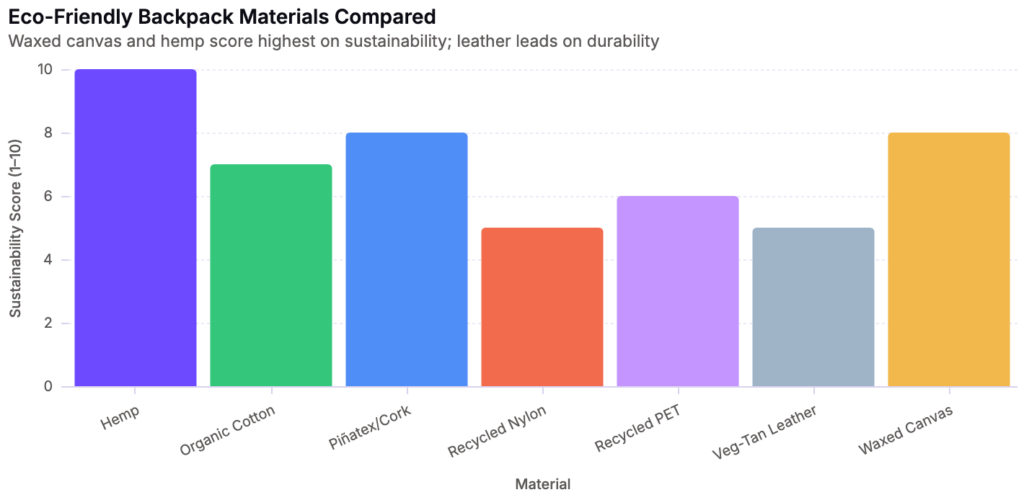
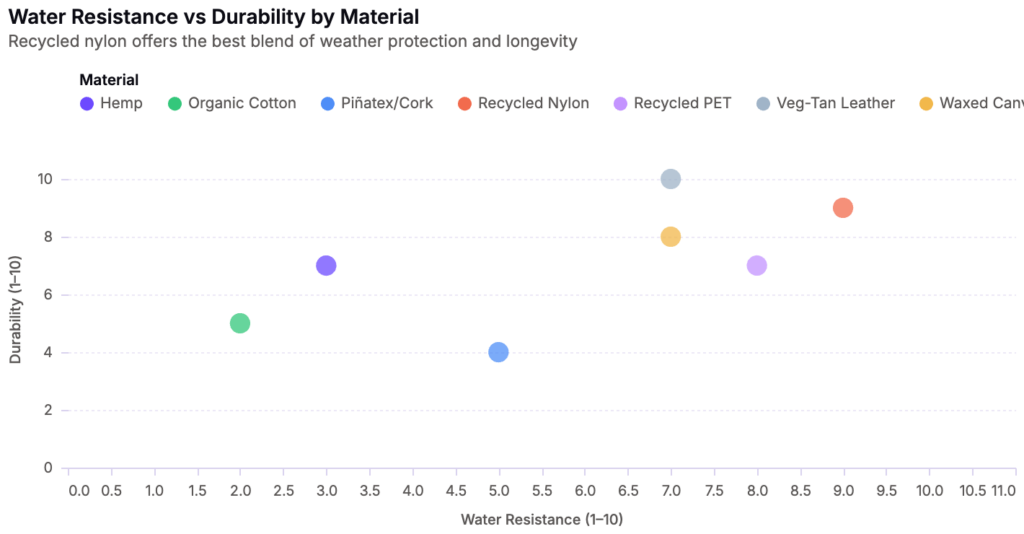
These chart illustrate a fundamental trade-off in sustainable backpack shopping: the most eco-friendly materials (hemp, organic cotton) tend to offer the least weather protection, while the most weather-resistant options (recycled nylon, rPET) are still fundamentally plastic. Waxed canvas occupies a sweet spot—natural, reasonably water-resistant, and highly durable—but it’s heavier than synthetic alternatives.
Choosing the Right Size: The Goldilocks Problem
Size is where most backpack buyers go wrong. Too small, and you’re constantly leaving things behind or awkwardly strapping items to the outside. Too large, and you’re tempted to fill empty space with unnecessary weight, straining your shoulders, back, and hips.
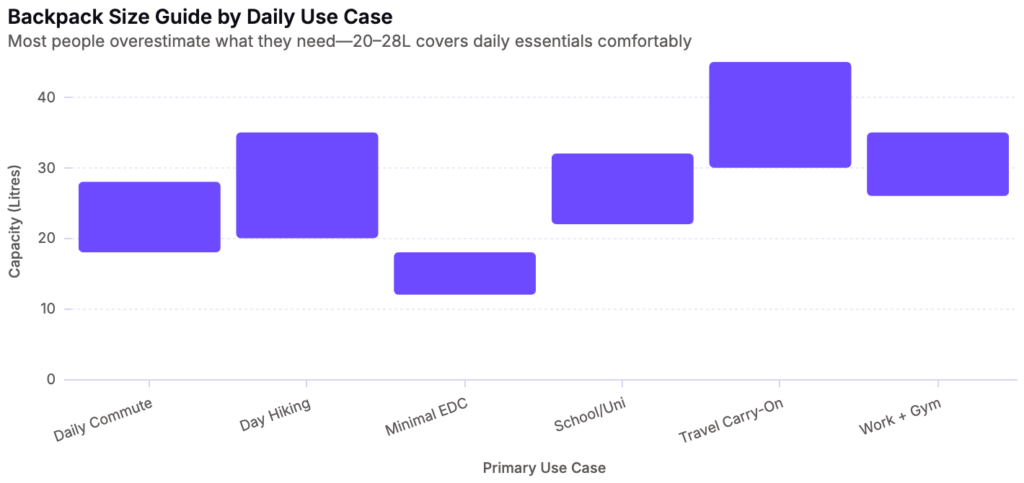
Here’s a practical framework based on capacity (measured in litres):
Rules of Thumb
- Under 18L: Minimalist everyday carry (EDC). Phone, wallet, keys, tablet, light jacket, water bottle. Great for urban life when you’ve embraced minimalism.
- 20–28L: The sweet spot for most people. Fits a laptop, lunch, change of clothes, water bottle, and miscellaneous essentials without becoming a black hole. This is the range that transitions seamlessly from work to gym to weekend hike.
- 30–35L: Students, cyclists, and those who genuinely carry bulky items (textbooks, gym shoes, climbing gear). At this size, pay close attention to hip belt support and load-lifting straps—your shoulders alone can’t manage 30+ pounds comfortably for extended periods.
- 40L+: Travel territory. These should have proper suspension systems (frame, padded hip belt, load lifters). If you’re carrying 40L every day, seriously evaluate whether you need to.
The Weight Penalty Nobody Talks About
Here’s an often-overlooked truth: a larger backpack encourages a heavier load, and the strain on your body increases nonlinearly. A 15-pound load carried on poorly designed shoulder straps for an hour causes measurable discomfort. The same weight distributed through a hip belt and frame is barely noticeable. Before sizing up, ask: Do I actually need to carry this, or am I packing out of anxiety?
Ergonomics: Protecting Your Back, Shoulders, and Posture
An eco-friendly backpack that destroys your posture isn’t truly sustainable—it’s just shifting environmental cost onto your body. Here’s what to look for:
Padded, contoured shoulder straps are non-negotiable. Look for at least 15mm of closed-cell foam, shaped to follow the curve of your shoulders rather than cutting straight across. Sternum straps (the small connector across your chest) prevent straps from sliding off shoulders and improve load stability dramatically—especially when cycling or walking briskly.
Hip belts matter more than people think, even on smaller packs. Even a lightweight webbing hip belt transfers 20–30% of load weight to your pelvis, which is structurally far better equipped to bear weight than your relatively delicate trapezius muscles.
Back panels should provide ventilation channels to reduce sweating and have enough rigidity to prevent the pack contents from pressing unevenly against your spine. Some eco-conscious brands use recycled mesh or natural cork panels.
Load distribution is the real ergonomic secret. Pack heaviest items closest to your spine and higher up. Lighter, bulkier items go in the outer compartments. This keeps your centre of gravity aligned and reduces the rotational torque that causes lower back pain.
What to Look for in an Eco-Conscious Brand
Beyond materials, the company behind your backpack matters enormously. Greenwashing is rampant in the outdoor industry—here’s a checklist for evaluating brand authenticity:
| Criteria | What to Look For |
|---|---|
| Material Transparency | Full disclosure of fabric composition, lining, hardware, and coatings. If a brand hides its material specs, that’s a red flag. |
| Supply Chain | Publishing factory locations, fair labour certifications (Fair Trade, SA8000), and traceability programs. |
| Repair Programs | Offering replacement parts, repair services, or lifetime warranties. A brand willing to fix your bag is invested in longevity. |
| Take-Back/Recycling | End-of-life programmes that accept old bags for recycling or upcycling rather than landfilling. |
| Certifications | Bluesign (chemical safety), GRS (Global Recycled Standard), GOTS (organic textile), LWG (leather working group). |
| Carbon Reporting | Publishing emissions data and setting reduction targets—ideally verified by third parties. |
Brands worth researching (this is not exhaustive, and you should verify current practices):
Patagonia (affiliate link) (longstanding environmental leadership, Black Hole bags use recycled materials, robust repair program),
Fjällräven (affiliate link) (G-1000 waxed fabric, re-waxing extends life indefinitely),
Topo Designs (affiliate link) (some styles use recycled materials, made-in-USA options),
Terra Nova and Cotopaxi (affiliate link) (repurposed fabric programmes),
and smaller artisanal makers who handcraft waxed canvas and leather packs in small batches.
As an Amazon Associate I earn from qualifying purchases.
Water Resistance and the Eco-Friendly Catch
Here’s the rub that catches many sustainable shoppers: most truly waterproof backpacks rely on synthetic coatings and membranes. Polyurethane (PU) coatings, DWR (durable water repellent) treatments, and thermoplastic polyurethane (TPU) linings are all derived from petrochemicals. And the most effective waterproofing technology—expanded PTFE (the membrane in Gore-Tex)—involves fluorinated compounds that persist indefinitely in the environment (PFAS, or “forever chemicals”).
So what’s the eco-conscious alternative for wet climates?
Waxed canvas, as discussed, provides respectable water resistance through a natural mechanism. When rain hits waxed fabric, the wax causes water to bead and roll off. It’s not fully waterproof—sustained downpours will eventually penetrate—but it handles light to moderate rain admirably. Crucially, you can re-wax the fabric periodically (every 6–12 months depending on use), restoring its water resistance and extending its life for years or decades. This is sustainability in practice: maintenance over replacement.
Vegetable-tanned leather offers similar natural water resistance, again requiring periodic conditioning with natural oils or waxes.
For truly waterproof needs (commuting by bike in heavy rain, hiking in monsoon conditions), you may need to accept a hybrid approach: a natural-material backpack paired with a separate rain cover (which can be made from recycled materials and used only when needed) or dry bags inside your pack for electronics and documents.
The Mindset Shift: Carrying Less Is the Ultimate Sustainability
Here’s where we need to get honest. No backpack—however eco-friendly its materials—is truly sustainable if you’re using it to haul around 35 pounds of things you don’t need. The most environmentally responsible backpack decision might not be about which backpack to buy, but about how much you’re carrying and why.
Auditing Your Essentials
Consider doing a weekly “pack audit.” Empty your bag completely and sort contents into three categories:
- Used today or will be used tomorrow – stays in the bag.
- Used in the past week – candidate for staying, but question whether it needs to live in your bag permanently.
- Hasn’t been touched in two weeks – remove it. If you need it unexpectedly, you’ll survive.
Most people find they can remove 20–40% of their bag’s contents through this exercise. Less weight means less strain on your body, less wear on the bag (extending its life), and—paradoxically—a greater sense of readiness, because you can actually find things quickly.
The Shared Culture Alternative
There’s a deeper philosophical point here worth considering. Much of what we carry is motivated by a desire for self-sufficiency—”I might need this, so I’d better have it.” But in communities with strong shared infrastructure, this burden shrinks dramatically:
- Workplaces with proper lockers eliminate the need to carry gym clothes both directions.
- Public libraries, maker spaces, and tool libraries mean you don’t need to own—or carry—specialised equipment.
- Community bike repair stations along commuting routes reduce the need for full tool kits.
- Shared kitchen facilities at co-working spaces mean you don’t need to lug lunch containers, cutlery, and condiments.
This isn’t about austerity—it’s about recognising that carrying everything yourself is a uniquely modern, individualistic assumption. Previous generations routinely relied on shared spaces and community infrastructure. Rebuilding that infrastructure, or simply tapping into what already exists, can lighten your load—literally and figuratively.
The most resilient “grab bag” for emergencies, after all, isn’t one stuffed with every conceivable item. It’s one with the essentials—documents, medications, cash, phone charger, first aid—organised so you can grab it and go, trusting that you can access additional resources through community networks.
Price vs Lifespan: The Real Cost Calculation
A £40 backpack that lasts two years costs you £20/year. A £150 waxed canvas pack that lasts twelve years costs you £12.50/year. And the latter almost certainly has a lower environmental footprint per year of use.
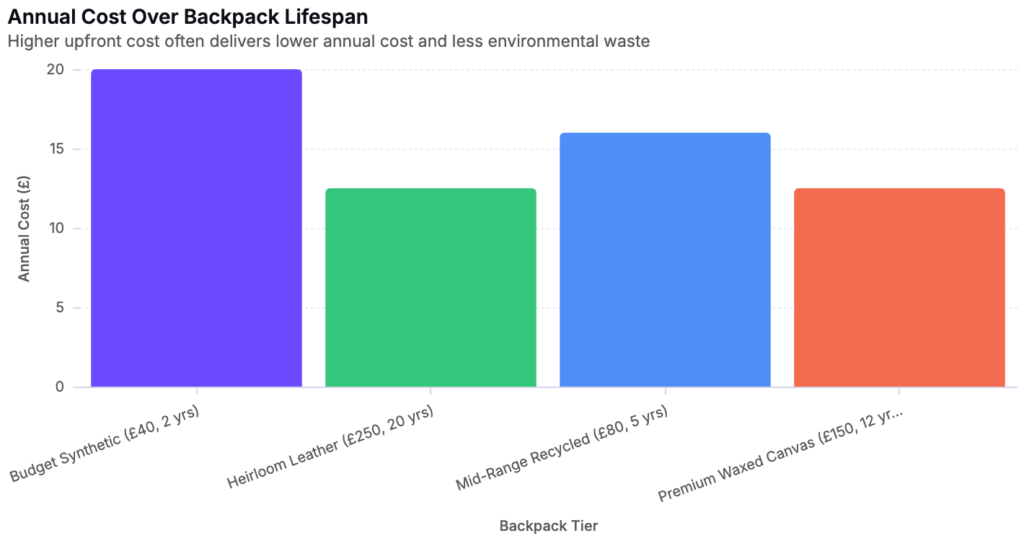

This isn’t to say everyone should spend £250 on a backpack. Budget constraints are real. But if you can afford the upfront investment, buying fewer, better things is both financially and ecologically smarter over time.
Frequently Asked Questions
Can an eco-friendly backpack be truly waterproof?
Not fully waterproof in the way a synthetic dry bag is—but it can be highly water-resistant. Waxed canvas and vegetable-tanned leather both repel water naturally and can be re-treated periodically. For genuinely waterproof needs, pair a natural-material bag with a recycled-content rain cover or internal dry bags. The trade-off is between absolute waterproofing and material sustainability.
How do I re-wax a waxed canvas backpack?
You’ll need a block of wax (beeswax, paraffin, or a commercially blended wax like Fjällräven’s Greenland Wax). Apply evenly across the fabric surface, then use a hair dryer on medium heat to melt the wax into the fibres. Let it cure for 24 hours. The process takes about 20 minutes of active effort and restores water resistance for 6–12 months. It’s satisfying, meditative work—and a key reason waxed canvas lasts decades.
Are recycled polyester backpacks actually better for the environment?
Yes, incrementally. Producing rPET uses approximately 50–70% less energy than virgin polyester and diverts plastic bottles from landfill. However, rPET is still plastic—it sheds microplastics, doesn’t biodegrade, and is rarely recyclable at end of life. It’s harm reduction, not a complete solution. If your priority is maximum sustainability, natural materials remain preferable; if you need high performance and water resistance, rPET is a reasonable compromise.
What’s the ideal capacity for someone who bikes to work and hikes on weekends?
Look for a 24–30L pack with compression straps. Compression lets you cinch the bag down for commute loads (looking sleek and reducing sway while cycling) and expand it for weekend trails. Prioritise a sternum strap (critical for cycling stability) and consider a removable hip belt. A waxed canvas or rPET body with a ventilated back panel is ideal.
Is leather ethical?
This is genuinely complex and depends on your ethical framework. Vegetable-tanned leather is a byproduct of the meat industry—if you consume dairy or meat, the leather exists regardless of whether you buy it. Full-grain, veg-tanned leather is biodegradable and can last 20+ years, making its per-year environmental impact very low. However, chrome tanning (the dominant method globally) is highly polluting, and some people object to leather on principle regardless of sourcing. If you choose leather, seek out vegetable-tanned, full-grain hides from tanneries with environmental certifications.
How can I make my current backpack last longer?
Empty it fully each week and shake out debris. Spot-clean stains rather than machine washing (which damages coatings and shortens fibre life). Store it unzipped in a dry place to prevent mould. Replace worn zipper pulls before zippers fail. Apply seam sealer to high-stress seams annually. If a strap or buckle breaks, contact the manufacturer—many offer repair services or sell replacement parts. Every year of extended life is a year of avoided manufacturing impact.
What about vegan leather backpacks—are they eco-friendly?
It varies enormously. Piñatex (pineapple leaf fibre) and cork are promising biodegradable options with relatively low impact. However, many “vegan leather” products are actually polyurethane-coated fabric—essentially plastic with a marketing-friendly name. These shed microplastics and don’t biodegrade. If you’re choosing vegan leather for environmental reasons (rather than ethical ones), scrutinise the specific material carefully.
Final Thoughts: Buy Once, Carry Mindfully
The most sustainable backpack is the one you already own, used thoughtfully and maintained with care. If you’re in the market for a new one, the hierarchy of environmental preference generally runs: repair your current bag → buy a high-quality used bag → invest in a durable natural-material pack → choose recycled synthetics → avoid virgin synthetic fast-fashion packs.
Within that framework, the ideal purchase for most people looks something like this: a 20–28L waxed canvas or high-recycled-content backpack, with proper shoulder strap padding, a sternum strap, and enough organisational pockets to keep essentials accessible without encouraging hoarding. Something that looks good on a train platform and on a forest trail. Something that can be repaired, re-waxed, and re-loved for a decade or more.
Because the real luxury in a chaotic world isn’t having everything with you—it’s knowing that what you have is enough, and that the bag on your back wasn’t bought at the planet’s expense.
Have a question about eco-friendly backpacks that we didn’t cover? Drop a comment below, and we’ll update this guide as new materials, brands, and innovations emerge.
Leave a Reply