
Every single day, millions of people reach for a disposable drink bottle — grab a coffee cup, pick up a bottled water, swing through a drive-through for a soda in a plastic cup with a straw. Convenience feels effortless. But that convenience comes with a staggering environmental cost that piles up faster than any of us care to admit.
This guide is designed to walk you through everything you need to know about switching from single-use drink containers to reusable tumblers and water bottles. Whether you’re motivated by sustainability, saving money long-term, keeping your drinks at the perfect temperature, or simply expressing your personal style, we’ll help you find the right reusable vessel for your lifestyle.
The Problem: Disposable Drink Waste Is Staggering
Let’s start with some perspective. Globally, humans purchase approximately one million plastic bottles per minute. Of those, only a fraction — some estimates suggest around 9% — actually get recycled. The rest end up in landfills, oceans, waterways, and scattered across landscapes where they take hundreds of years to decompose.
But here’s what most people miss: even when a plastic bottle does make it into the recycling stream, the cap often doesn’t. Bottle caps are made from a different type of plastic than the bottle itself (typically HDPE vs. PET), which means many municipal recycling facilities either can’t process them or won’t bother separating them. Millions of caps are landfilled or become ocean debris every year.
And then there are straws. Plastic drinking straws are virtually never recycled — they’re too lightweight to be captured by standard sorting machinery, and they’re too small to be economically viable for recyclers. They consistently rank among the top ten items found during beach cleanups worldwide. While paper straws have gained popularity as an alternative, many users find them frustratingly soggy and short-lived, which brings us back to the core issue: people just want a good drinking experience.
The bottom line? Even “recyclable” disposable options are far from a real solution. The only genuinely sustainable approach is reuse — and that’s where tumblers and water bottles come in.
Why Reusable Tumblers & Water Bottles Are the Answer
Switching to a reusable tumbler or water bottle addresses the waste problem directly. Instead of contributing to the mountain of single-use plastics, you invest in a durable container that can last for years — sometimes decades — with proper care. Over its lifetime, a single reusable bottle can replace thousands of disposable ones.
But sustainability isn’t the only benefit. Here are several reasons why making the switch improves your everyday experience:
Superior Temperature Retention: Most quality reusable bottles and tumblers feature double-wall vacuum insulation. This technology creates an airless gap between two stainless steel walls, dramatically reducing heat transfer. Cold drinks stay icy for up to 24 hours or more. Hot beverages like coffee or tea remain piping hot for 6–12 hours. Compare that to a flimsy plastic bottle or paper coffee cup that lets your drink go lukewarm within the hour.
Personal Expression: Unlike a generic disposable bottle, a reusable tumbler or water bottle becomes an extension of your personality. Brands offer a dizzying array of colors — from muted earth tones to vibrant metallic finishes. Patterns range from minimalist geometric designs to bold florals and everything in between. And then there’s the sticker culture: many enthusiasts adorn their Yeti, Hydro Flask, or Stanley tumblers with custom stickers showcasing their hobbies, travels, favorite bands, or sense of humor. Your drink container becomes a canvas.
Functional Variety: Reusable vessels come in configurations that disposables simply can’t match. Want a built-in straw for easy sipping on the go? There’s a tumbler for that. Need a sturdy handle for carrying your giant hydration companion everywhere? Several brands have you covered. Prefer a flip-top lid, a screw cap, a chug spout, or a wide-mouth opening for ice? The options are nearly endless, and many brands offer interchangeable lids so you can customize your setup.
Cost Savings Over Time: While the upfront investment is higher than a single disposable bottle, the math quickly tips in favor of reuse. If you’re someone who buys bottled water, specialty coffees, or fountain drinks regularly, a reusable container pays for itself in a matter of weeks to months.
Types of Reusable Drink Containers Explained
Before diving into features and recommendations, let’s clarify the terminology, since “tumbler” and “water bottle” are sometimes used interchangeably but actually refer to different form factors.
Water Bottles
Water bottles are designed primarily for portability and active use. They typically feature a narrower profile, a secure sealing lid (screw cap, flip-top, or chug spout), and are built to be tossed in a backpack, gym bag, or cup holder. They tend to hold anywhere from 12 to 40 ounces and prioritize leak-proof designs over open-drinking convenience.
Best for: Gym-goers, hikers, students, commuters, and anyone who needs a sealed, spill-proof container for on-the-go hydration.
Tumblers
Tumblers are broader, often wider vessels that prioritize drinking comfort over absolute portability. They typically feature a straw lid or a press-in slider lid, and their wider base makes them ideal for desk use, car cup holders (in many cases), and leisurely sipping. Tumblers commonly range from 20 to 40+ ounces and often include a handle for easier carrying.
Best for: Office workers, road-trippers, desk sippers, iced coffee lovers, and anyone who prefers straw-based drinking.
Hybrid/Multi-Use Vessels
Some modern designs blur the line — offering both a carry handle and a straw, or coming with multiple interchangeable lid types. These versatile options are ideal for people who want one container that adapts to multiple situations throughout the day.
Best for: People who want maximum versatility from a single purchase.
Key Features to Consider When Choosing
With the basics covered, let’s dig into the specific features that differentiate products within each category. Understanding these will help you match a product to your specific needs.
Insulation Technology
The vast majority of premium reusable drinkware uses double-wall vacuum insulation. Two layers of stainless steel are joined with a vacuum-sealed gap between them. Because there’s no air (and therefore no medium for heat transfer), this design is remarkably effective at maintaining temperature.
Lower-cost options may use double-wall construction without a true vacuum, or even single-wall designs. These offer some insulation benefit but fall significantly short of vacuum-insulated performance. If temperature retention is a priority — especially for hot drinks or all-day ice retention — vacuum insulation is essential.
Some ultra-budget options use plastic double-wall construction. These are lightweight and inexpensive but don’t insulate as effectively and may retain odors or flavors over time.
Lid Types
The lid is arguably the most important functional component of any reusable vessel. Common lid styles include:
- Straw Lids: Feature a hole for a reusable straw. Excellent for cold drinks and easy sipping while driving or working. Look for models with a sliding cover or flip closure to keep the straw clean when not in use.
- Chug Spouts: A raised, angled spout designed for taking large gulps quickly. Popular among athletes and outdoor enthusiasts.
- Screw Caps: The classic, most leak-proof option. Great for tossing in a bag without worry, though less convenient for quick sips.
- Flip-Top/Press-Button Lids: One-handed operation with a spring-loaded mechanism. Convenient but more complex, meaning more parts to clean and a higher likelihood of mechanical failure over time.
- Slider Lids: A lever that slides open to reveal a drinking opening. Common on coffee tumblers and travel mugs.
Material Quality
- 18/8 Stainless Steel: The gold standard for reusable drinkware. It’s food-safe, resistant to corrosion, doesn’t impart flavors, and is highly durable. All premium brands use this material.
- Tritan Plastic (BPA-Free): A shatter-resistant, clear plastic used in many lower-cost bottles. Lighter than steel and allows you to see contents, but doesn’t insulate as well and may scratch over time.
- Glass: Offers the purest taste — no flavor retention whatsoever — but is heavy, fragile, and generally impractical for portable use. Some brands offer silicone sleeves for protection.
- Silicone/Collapsible: Ideal for travel and space-saving. These can be rolled or folded when empty. Trade-offs include less insulation and a somewhat floppy drinking experience.
Size and Capacity
| Capacity Range | Best Use Case | Portability |
|---|---|---|
| 12–18 oz | Desk use, kids, short outings | Very portable, fits all cup holders |
| 20–30 oz | Daily driver, commuting, gym | Portable, most cup-holder friendly |
| 32–40 oz | All-day hydration, outdoor activities | Less portable, may not fit all cup holders |
| 40+ oz | Serious hydration goals, office desk | Bulky; often includes a handle for carrying |
Handle Options
Handles have become increasingly popular, especially on larger-capacity tumblers. A well-designed handle makes carrying a 40-ounce vessel comfortable and natural. Look for handles that are integrated into the lid (allowing 360-degree rotation) or molded into the tumbler body for structural durability.
Straw Considerations
If you opt for a straw-equipped vessel, consider the straw material:
- Reusable Plastic Straws: Lightweight, clear, and affordable. Found in most tumbler kits. May scratch over time.
- Stainless Steel Straws: Extremely durable and easy to clean, but conduct temperature — beware of very cold or very hot drinks. Often come with silicone tips for comfort.
- Silicone Straws: Soft, flexible, and kid-friendly. Won’t conduct temperature. May retain some flavors over time.
Regardless of material, always use a straw cleaning brush — straws are notorious breeding grounds for bacteria if not properly maintained.
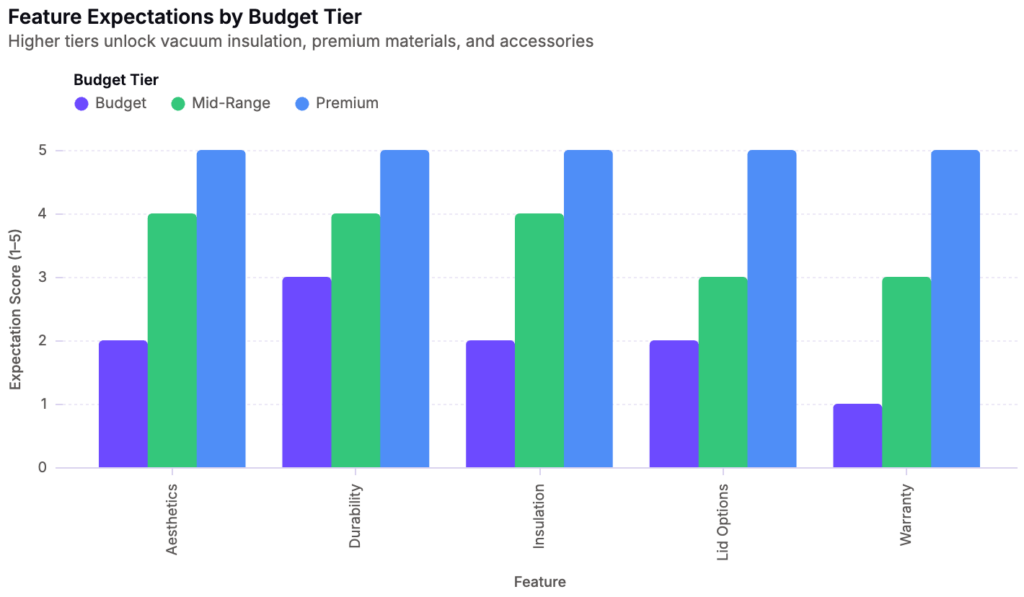
Budget Tier Comparison
Rather than citing specific prices (which fluctuate constantly due to sales, availability, and retailer pricing), here’s a breakdown of what you can expect at each budget tier. All Amazon product links are affiliate links, meaning we may earn a commission at no additional cost to you.
Budget Tier ($)
At this tier, you’ll find single-wall or basic double-wall stainless steel bottles, Tritan plastic tumblers, and simpler designs. Expect minimal accessories, fewer color options, and basic lids (often just a screw cap or simple straw lid). Insulation performance will be modest — cold drinks may stay cool for a few hours, but don’t expect ice to last overnight. Warranty coverage is typically limited or nonexistent.
Who it’s for: First-time buyers, casual users, kids, or anyone testing the waters of reusable drinkware without committing significant funds. Also great for bulk purchases (office teams, event giveaways).
👉 Browse Budget Tumblers on Amazon (affiliate link)
Mid-Range Tier ($$)
This is where vacuum insulation becomes standard. You’ll find 18/8 stainless steel construction, double-wall vacuum insulation with respectable temperature retention (cold for 12–18 hours, hot for 6–8 hours), and a decent selection of colors and finishes. Lid options expand — many brands at this tier offer straw lids, chug spouts, and slider lids. Warranties are typically 1–5 years.
Who it’s for: Most everyday users. This tier hits the sweet spot of performance, durability, and value. If you’re replacing daily disposable drinks and want something that genuinely outperforms them, this is your starting point.
👉 Browse Mid-Range Vacuum Bottles on Amazon (affiliate link)
Premium Tier ($$$)
Premium-tier drinkware represents the best of the best. Expect top-tier vacuum insulation (cold retention up to 24+ hours, hot up to 12+ hours), extensive color and finish palettes including powder-coated and metallic options, modular accessory ecosystems (interchangeable lids, handles, boot protectors, straw packs), and robust warranties — often lifetime or “limited lifetime.” Build quality and attention to detail are noticeably superior, and brand communities offer sticker swaps, customization guides, and social sharing.
Who it’s for: Daily heavy users, outdoor enthusiasts, gifting, brand loyalists, and anyone who wants a “forever bottle” that performs flawlessly for years.
👉 Browse Premium Insulated Tumblers on Amazon (affiliate link)
Tumbler vs. Water Bottle: Quick Comparison
Not sure which form factor suits you? This chart breaks down the key differences:

The Maintenance Catch: What Nobody Tells You
Here’s the honest truth that many buying guides gloss over: reusable drink containers require ongoing maintenance, and neglecting it can create health concerns that single-use bottles never pose.
Why Cleaning Matters
Every time you drink from a tumbler or bottle, you introduce saliva, food particles, and potentially sugary residues into the vessel. Over time, this creates an environment where bacteria, mold, and mildew can flourish — particularly in damp, dark, and warm conditions (which describes the interior of a sealed bottle perfectly). Studies have found that unwashed reusable bottles can harbor significantly more bacteria than a toilet seat.
The Problem Areas
- Straws: The inside of a straw is the single hardest component to clean properly. A quick rinse is not enough — you need a dedicated straw brush to scrub the full interior length.
- Lid Mechanisms: Flip-top lids, slider mechanisms, and press-button releases have small crevices and moving parts where gunk accumulates. Many premium lids can be disassembled for cleaning, but you need to do so regularly.
- Thread Seals: The threading where the lid screws onto the bottle collects residue. An old toothbrush works wonders here.
- Bottom Seams: Many tumblers have a slight ridge or seam at the bottom interior where liquid pools. Pay special attention to this area during washing.
- Gaskets/O-Rings: Silicone gaskets that create the leak-proof seal are prime real estate for mold growth. Remove them periodically and soak in warm, soapy water or a diluted vinegar solution.
Recommended Cleaning Routine
Daily: Rinse thoroughly with warm water after each use. At minimum, wash with warm soapy water and a bottle brush every evening.
Weekly Deep Clean: Disassemble all removable components (lids, straws, gaskets, sliders). Soak in warm water with dish soap or a mixture of water and white vinegar. Scrub all surfaces with appropriate brushes. Allow all parts to air-dry fully — moisture is the enemy.
Monthly Sterilization: Run dishwasher-safe components through a heated dishwasher cycle. For hand-wash-only items, a soak in a diluted bleach solution (1 teaspoon per quart of water) followed by thorough rinsing provides sterilization. Alternatively, bottle-cleaning tablets (widely available) offer a fizz-action deep clean that reaches areas brushes can’t.
Drying Is Non-Negotiable
Even the cleanest bottle will develop odors and bacterial growth if stored damp. Always store your vessel with the lid off and allow full air circulation. Store upside down on a drying rack when possible. Never store a sealed, damp bottle — you’re essentially creating a terrarium for microbes.
Additional Considerations
Dishwasher Safety
Not all premium drinkware is dishwasher safe. Powder-coated finishes can degrade over time in high-heat dishwasher cycles. Vacuum seals can theoretically be compromised by extreme temperatures (though modern manufacturing has largely mitigated this). Always check the manufacturer’s recommendations. If dishwasher cleaning is important to you, filter for “dishwasher safe” explicitly.
Cup Holder Compatibility
If you spend significant time driving, cup holder compatibility is a practical consideration. Most bottles up to ~3 inches in diameter fit standard car cup holders. Large-capacity tumblers (40 oz+) often exceed this and may require a vehicle with oversized cup holders or an aftermarket adapter. Handles that rotate 360 degrees can help navigate tight cup holder spaces.
Sustainability of the Container Itself
It’s worth noting that producing a stainless steel water bottle requires significantly more energy and resources than producing a single plastic bottle. Various lifecycle analyses suggest that a reusable bottle needs to replace somewhere between 10 and 80 disposable bottles (depending on the study and assumptions) to “break even” environmentally. Given that a quality reusable vessel replaces thousands of disposables over its lifespan, this threshold is easily cleared — but it underscores the importance of actually reusing your reusable. Buying five different “reusable” bottles that each sit unused in a cabinet is not an environmental win.
Sticker Culture and Customization
One of the most delightful aspects of the reusable tumbler movement is the sticker culture. Vinyl, waterproof, and dishwasher-safe stickers let you transform a plain vessel into a deeply personal statement piece. Travel stickers, band logos, funny quotes, nature illustrations, anime characters — if you can imagine it, there’s a sticker for it. Some enthusiasts curate their tumblers seasonally, swapping sticker collections throughout the year. Just be aware that applying stickers over powder-coated finishes is fine, but removing them may leave adhesive residue that requires careful cleaning.
👉 Browse Waterproof Stickers for Tumblers on Amazon (affiliate link)
Accessories Worth Considering
- Silicone Boots: Protect the bottom of your tumbler from dents and scratches while providing grip on smooth surfaces.
- Replacement Straws: Stock up — straws get lost, bent, or worn over time.
- Handle Attachments: Aftermarket handles that fit over existing lids for added carrying convenience.
- Cleaning Brush Sets: Dedicated bottle brushes and straw brushes are essential for proper hygiene.
- Carry Pouches: Neoprene or fabric pouches that protect your vessel and provide additional insulation.
👉 Browse Tumbler Accessories on Amazon (affiliate link)
Frequently Asked Questions
How long do insulated tumblers and water bottles typically last?
With proper care, a high-quality stainless steel vacuum-insulated bottle or tumbler can last for many years — sometimes 5 to 10+ years. The vacuum seal is the most vulnerable component; if the bottle is dropped hard enough to dent the inner wall, the vacuum can be lost, and insulation performance will drop. The exterior finish (especially powder coating) may show wear over time, but this is cosmetic rather than functional.
Can I put hot drinks in a tumbler designed for cold drinks?
In most cases, yes — the vacuum insulation works for both hot and cold. However, lids matter. A straw lid with a straw inserted is not suitable for hot liquids, as the straw can become dangerously hot and cause burns. Switch to a slider or sip lid for hot beverages. Some straws (particularly metal ones) conduct heat efficiently and can deliver scalding liquid directly to your lips.
Are stainless steel bottles safe for acidic drinks?
Yes. 18/8 stainless steel is highly resistant to corrosion from acidic beverages like lemon water, sports drinks, or fruit-infused water. However, prolonged storage (multiple days) of highly acidic drinks is not recommended as it can eventually affect the taste. Stick to daily use and regular cleaning.
Will my bottle sweat with cold drinks?
Vacuum-insulated stainless steel bottles should not sweat externally — that’s one of their key advantages. If you notice condensation forming on the outside, it likely means the vacuum seal has been compromised (possibly from a drop or dent). Single-wall bottles and some lower-quality double-wall bottles will sweat.
How do I remove stubborn odors from my tumbler?
Try one of these methods:
- Baking soda paste: Mix baking soda with water to form a paste. Apply to the interior, let sit for several hours, then scrub and rinse.
- Vinegar soak: Fill with equal parts white vinegar and water. Let sit overnight, then wash thoroughly.
- Denture tablets: Drop a denture-cleaning tablet in with warm water. Let fizz for 15–20 minutes, then wash.
- Bottle cleaning tablets: Commercial products designed specifically for this purpose are highly effective and convenient.
Is it safe to put my tumbler in the freezer?
Generally, no. Freezing a vacuum-insulated bottle can damage the vacuum seal due to liquid expansion. If you want colder drinks, add ice cubes to your beverage instead. Some manufacturers explicitly state that freezer use voids the warranty.
What size tumbler fits in a standard car cup holder?
Most standard car cup holders accommodate containers up to approximately 3 inches in diameter. A 20-ounce tumbler typically fits comfortably. Larger 30-40 ounce tumblers may fit depending on the vehicle, but many require oversized holders or adapters. If this is a primary concern, check dimensions before purchasing.
Are glass bottles a viable eco-friendly option?
Glass is infinitely recyclable and doesn’t retain flavors or odors, making it an excellent choice from a purity standpoint. However, glass is heavy and breakable, making it impractical for many use cases. Glass bottles with protective silicone sleeves are available and work well for home and light office use, but they’re not ideal for active or outdoor scenarios.
Making the Switch: A Step-by-Step Action Plan
Ready to commit? Here’s a practical roadmap:
- Assess your daily drinking habits. What do you drink most (water, coffee, smoothies)? Where do you drink most (car, desk, gym)? This determines your ideal form factor (bottle vs. tumbler), capacity, and lid type.
- Set your budget tier. Decide whether you want a budget, mid-range, or premium option. Remember: a mid-range vacuum-insulated vessel offers the best balance of performance and value for most users.
- Choose your features. Based on step 1, prioritize lid type (straw, chug, screw cap), handle (yes/no), capacity (oz), and any specific requirements (dishwasher safe, particular color, cup-holder compatible).
- Order your vessel and essential accessories. At minimum, pick up a cleaning brush set and a straw brush if applicable. A silicone boot is a worthwhile investment for longevity.
- Establish a cleaning routine from day one. Commit to daily rinsing, weekly deep cleans, and proper drying/storage. This is what separates a beloved daily companion from a science experiment.
- Personalize it. Add stickers, choose a color you love, make it yours. The more attached you are to your vessel, the more likely you are to actually use it — and that’s the entire point.
- Track your impact. If you were previously buying one bottled water per day, that’s 365 bottles per year eliminated. Seeing the numbers adds motivation and satisfaction.
Final Thoughts
The shift from disposable drink containers to reusable tumblers and water bottles is one of the most accessible, impactful lifestyle changes an individual can make. It reduces landfill waste, cuts ocean plastic pollution, saves money over time, keeps your drinks at optimal temperature, and gives you a canvas for personal expression — all while being genuinely enjoyable to use.
The key to success isn’t finding the “perfect” bottle. It’s finding the right bottle for your life and committing to the simple maintenance routine that keeps it hygienic and functional for years. With the information in this guide, you’re well-equipped to make that choice confidently.
Now go find your forever bottle.
This article contains affiliate links to Amazon. As an Amazon Associate, we may earn from qualifying purchases at no additional cost to you. Recommendations are based on feature categories and budget tiers, not specific brand endorsements.
Leave a Reply